What trusteeship
asks of us now
A reflection on thirty years of trusteeship: the value of challenge, the discipline of good decision-making and why a smooth board meeting is not necessarily the sign of a well-run charity.
Lured by the promise of decent sandwiches and a general inclination to try and do something good, I joined my first charity board 30 years ago, early in my technology career and long before I’d even thought about, let alone studied, law. Since then, I’ve served on quite a few boards with very different purposes. But although those purposes have been disparate, each board has taught me something about the distinction between agreeing to be responsible for something and knowing how to exercise that responsibility properly and well.
No one in their right mind becomes a trustee for the pleasure of reading a board pack. Nonetheless, I’ve spent a huge amount of time doing exactly that, and, in that time, I’ve seen papers that are good, bad and indifferent. A good paper brings a complicated decision into focus. A bad one leaves the board unclear about what it is actually being asked to decide, or why. And then there are the routine space-fillers: reports for the sake of reporting, which end up hiding the useful stuff. Perhaps the most dangerous of all is the paper that seems to answer everything, expects no challenge and invites a moderately unthinking, unanimous nod of the collective head.
Figures can be unassailably accurate but still rest on assumptions nobody has tested. A risk may be sitting there, neatly coloured in on a grid, without anyone having thought very hard about what would actually happen if it came to pass. And a recommendation that makes perfect sense on paper may look rather different to the people who would have to put it into practice. Trustees have to read beyond the reassuring surface. And sometimes the more confidently a paper is written, the more important it is to scratch beneath that reassuring surface.
Over time, I’ve come to value the trustee who says, ‘I’m sorry, I don’t understand that’ or, better still, ‘I’m sorry, I don’t agree’ or, best of all, ‘We’ve been thinking about this for ages now and still not done enough to fix whatever-it-is.’ The apologies are unnecessary, of course. As I write this, I’m thinking of my colleague and friend Dr Elizabeth Sparrow. During my time as Chair of the WCIT Charity, I could usually expect her to throw a question or an observation into the mix, even when the rest of the board felt perilously close to reaching a decision.
I say ‘over time’ because I did not always welcome that sort of interruption. In my early days of chairing, I wanted to get decisions made and sorted, move on and change things quickly. I sometimes mistook challenge for an impediment to getting stuff done. But it’s the challenge that’s important. Every board needs an Elizabeth Sparrow. When she came to the end of her term, I encouraged John Angel, a man with the same sort of questioning mind, to apply to take her place. And to all trustees, myself included, I would say: be more Elizabeth.
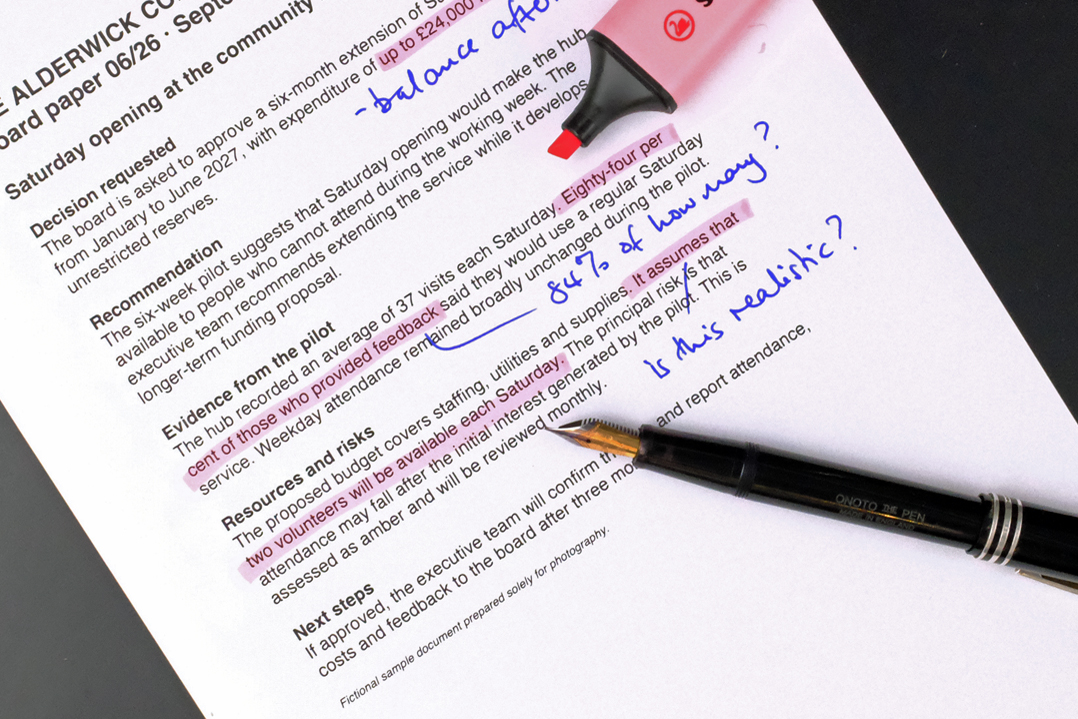
Good decisions begin by testing what appears settled. This fictional board paper was created for the photograph.
Making decisions well
We mustn’t lose sight, amid all this, of what the regulator requires of us. The Charity Commission’s guidance on trustee decision-making actually includes saying when you do not understand something among its examples of acting in good faith. It expects trustees to act within their powers, make decisions on enough relevant information, manage conflicts of interest and exercise independent judgement in the charity’s best interests. For significant decisions, the record should be clear enough for someone else to understand what the board considered and how and why it reached its conclusion. Asking an awkward question isn’t a departure from that duty at all. Quite often, it’s how we fulfil it.
The same guidance says that trustees are not expected to see into the future. This is just as well. Not only is it impossible, but if I could do that, I’d have won the Lottery by now, although I suspect I would still be chairing charities. And, as I know, a decision may turn out badly even though it’s been made well. In the inevitable follow-up, attention turns to what we could reasonably have known at the time and how we reached our conclusion. Even though minutes may not always be the most riveting read, they do allow us to show our working should we ever come under scrutiny.
So, minutes are useful for recording how we reached a decision. But they cannot do the thinking for us, and, while I’m on the subject, neither can AI. AI can certainly help prepare a board paper (which will probably be too long) or give a time-poor trustee a quicker way around a substantial board pack. But remarkably fluent prose can conceal a missing assumption, or, worse still, a source that simply doesn’t exist. The risk runs the other way too. A trustee can produce an impressive AI-drafted response to a paper without ever quite grappling with the evidence personally. Taken to the extreme, AI could be responding to AI. I’m not suggesting this happens at any charity with which I work or arguing for a ban; but AI cannot replace reading, checking, thinking and forming a view. More practically, confidential papers should not be fed into an external service without understanding how their contents will be handled. And the Charity Commission is clear that, however they get there, trustees remain responsible for their decisions.
Governing without interfering
None of this means trustees must do everyone else’s job. There is a great deal of work that can, and must, be left to others. This is naturally harder in smaller charities where the line between governing and doing is usually blurred. Charity boards delegate work for very good reasons. Executives and staff usually (and should) know far more about daily operations than the people who meet around the board table once every few months and in the occasional subcommittee. Operational staff need the authority and the space to do their jobs. But, as the Commission also makes clear in its essential trustee guidance, delegation does not remove the board’s overall responsibility. We need to know where authority sits, what information is coming back to us, and when a decision belongs with trustees collectively.
I have come to think that a board’s relationship with its executive team tells you a great deal about the charity’s health. Trustees should expect clear information and be prepared to challenge it. Executives should be able to describe a problem before they have solved it. And if a board reacts badly whenever it hears difficult news, it shouldn’t be surprised when difficult news arrives late.
A board can, and must, respond firmly to a serious problem without punishing the person who raised it. There is kindness in doing this well. By that I don’t mean avoiding an awkward conversation until it becomes an urgent one, but more like taking care over how a challenge is put, listening properly and patiently to the answer, and remembering that the person presenting difficult news may have been living with the situation for a while. None of that requires the board to become less rigorous about its duties.
Much of the work that makes a board better is routine, requires patience, and is usually fairly unglamorous: improving induction, asking for better evidence, and making room for new trustees to contribute. The Commission’s guidance on finding and appointing trustees is a useful reminder that an appointment is only the beginning. We owe new colleagues more than a welcome and a large pile of papers. They need to understand enough about the charity to challenge us, and those of us who have been around longer need to be willing to hear them. Sometimes the benefit of the board’s work will be hard to point to. A problem that was noticed and dealt with early doesn’t make for an especially dramatic entry in the annual report: sometimes a board’s most useful achievement is that a problem never becomes a crisis.
So, with 30 years’ experience under my ever-expanding belt, I still enjoy a decent sandwich and a meeting that finishes on time. But if a meeting doesn’t finish on time, I hope it’s because someone felt able to ask a question we needed to think about and resolve together. And, in response to my opening question, I think trusteeship asks us to be sufficiently informed, to make room for honest challenge and, when the meeting is over, to remain answerable for the decisions we made together.
Origin story
This article grew out of thirty years spent around charity board tables, and from reflecting on the people who taught me that good governance depends upon thoughtful challenge - not simply a smooth meeting and a unanimous vote.