Learning to decide
Reflections on judgement, education and the habits of thought that help us navigate uncertainty.
Most of my professional life involves making decisions. With the Parole Board for England and Wales, it is whether it remains necessary for the protection of the public that a prisoner remains confined, whether decisions made by colleagues are fair, rational and lawful, and whether certain evidence should be disclosed. With the Cabinet Office Community and Voluntary Service Honours Committee, it is whether an exceptional individual should receive a national honour, and, if so, at what level. With Prior's Court Foundation and The Inside Out Trust, it is about governance, strategy and organisational direction to support autistic young people and prison leavers: both vulnerable communities.
As with every other skill, judgement and decision-making must be learned and developed. But no one ever taught me how to make decisions. Experience, of course, plays a key role. So does discipline and structured reasoning, together with an eye on ‘the law of unintended consequences’ (including the unintended impact on the comms team). And sometimes, the confidence to conclude that doing nothing is the right thing. Or getting on and making a decision based on incomplete or imperfect information: waiting for perfection would mean no decision would ever be made.
So, what is the role of education in all this? I suggest that it is twofold. First, providing the technical knowledge needed in some decision-making contexts: the public would not be happy entrusting decisions about nuclear safety to someone who only had a degree in fine art. But second, and less dependent on subject, is the encouragement of intellectual curiosity, the development of structured thought, and the recognition that tricky decisions need proper attention. In that sense, and in the best tradition of the liberal arts and sciences, education is concerned with how we think as much as what we know.
How judgement develops
As a young boy, my only exposure to higher education was through my grandfather who, in retirement, worked as a porter at the University of Reading. When studying for my A levels at Reading School, I would often drive my battered Mini to the campus and read quietly in the university library. And it was this experience that strengthened my resolve to get decent results and go to university myself, as I ultimately did.
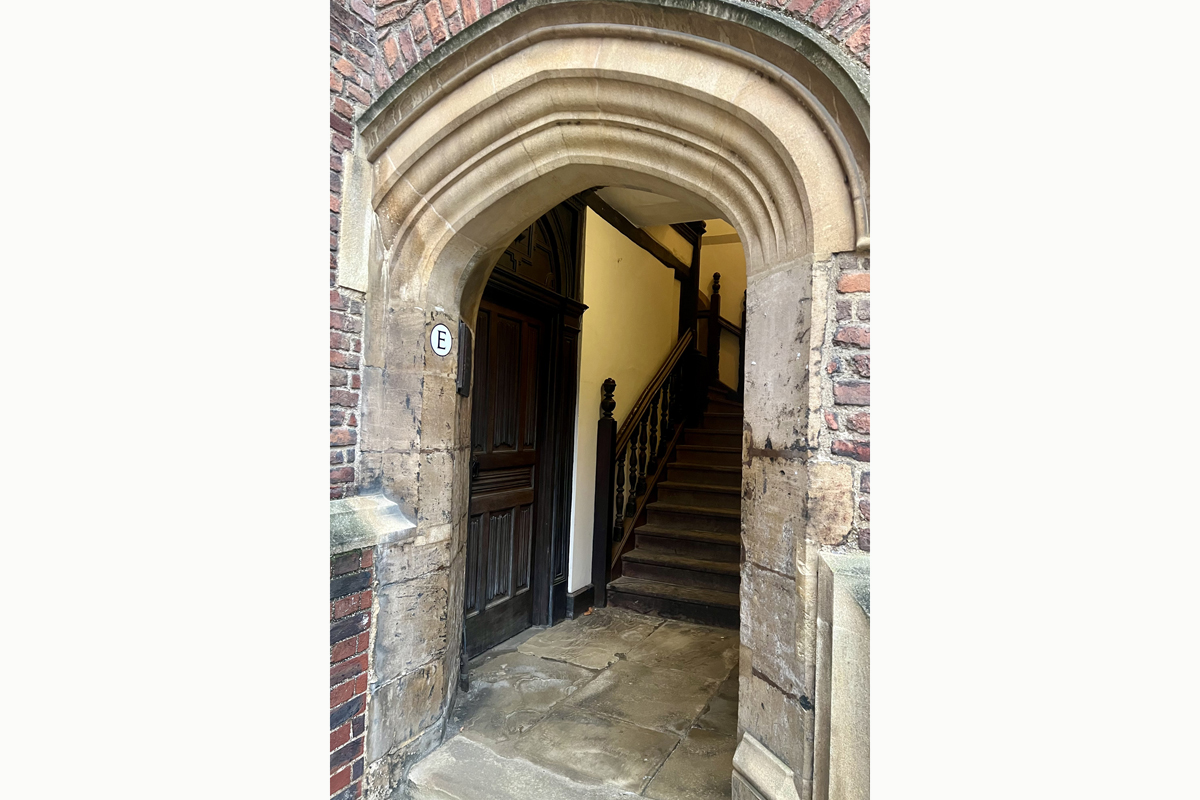
I’ve forgotten almost everything from my first degree at St John's College, Cambridge. I no longer have to construct mathematical models of unstable cavitation of bubbles in fluids, spell 'sonoluminescence', or try not to blow up photomultiplier tubes. But I do remember the process of learning to think and reason like a scientist.
And later on, thanks to The Open University, this was enhanced by learning to think and reason like a lawyer. At the most basic level, physics and law are both simply a set of rules that exist in a wider world of uncertainty and require logic, reasoning and careful thought to apply them to real-world problems.
Education in an age of intelligent tools
The extraordinarily rapid development of capable artificial intelligence tools means these underlying intellectual habits are even more important than before. AI can help with analysis, synthesis, and writing – often with startling fluency (on the face of it at least). But we need to add ‘use AI responsibly’ to ‘gamble responsibly’ and ‘drink responsibly’. And no matter how sophisticated, tools cannot (yet, at least) replace the human capacity to evaluate, question and exercise judgement based on experience and sustained education, rather than on billions of probabilistic calculations. They cannot appreciate or carry the human emotional weight often involved in decision-making, nor can they replicate uniquely human creativity.
More broadly, the responsible use of any technology depends upon understanding its limitations as well as its strengths. And its capacity for causing harm as well as doing good. As a technologist now working within the criminal justice system, the governance of risks emerging from new technologies fascinates me even more now than it did when it formed the subject of my PhD at the School of Law - University of Leeds back in 2008. Without disciplinary knowledge (and this is where the subject-matter expertise element of education comes into play) there is a real risk that AI output will be accepted without sufficient scrutiny or that efficiency and speed will replace thought and understanding. The real irony here is that the more capable the technology becomes, the more important the underlying human intellectual foundations will need to be.
Decision-makers often find themselves in uncertain territory. Precedents may help, but rarely determine outcomes entirely. AI may help but can be dangerous without disciplinary knowledge. Experience may help, but does not remove the need for reflection. And no tool, or human, can perfectly predict the future consequences of a decision.
It is education that draws these strands of judgement together: the ability to assess the extent to which a precedent is analogous or distinguishable, the subject knowledge that determines the usefulness or accuracy of an AI assistant, and, most importantly, the ability to think (as far as anyone can) through the consequences of a decision. Information may now be abundant, but judgement is not.
The ability to weigh evidence, distinguish analogy from difference, and anticipate consequences still depends upon habits of thought formed over time. That is why education matters. And that is why universities continue to play an essential role in public life.
Origin story
I first wrote and published this piece on LinkedIn after an event at the University of Reading. The Annual Edith Morley Lecture 2026 - A Celebration of Women - 100 Years of Courage, Legacy, and Changemakers - featured a live in-conversation interview with Dr Alice Mpofu-Coles, Senior Research Fellow in the Department of Geography and Environmental Science and the then Mayor of Reading.
I asked Alice about the civic responsibilities of universities to the communities in which they exist. Following that conversation, this short article reflects on the role education plays in developing the thinking skills that support responsible decision-making, and why universities remain relevant even as AI tools become increasingly capable.