Connected, not planned
My working life has moved through science, technology, law, education, public service and civil society. You’d be forgiven for thinking I’d made it up as I went along, but the connections have only become clear over time.
Born the illegitimate son of a Polish immigrant and a one-legged telephonist…
Since I was about 20, I have always said that would be the opening half-sentence of my autobiography. The other half was always going to be some variation on '…Stefan went on to do X'. Ideally, X would be a Great and Very Important Thing. The opening half is entirely true, but isn’t the sort of sentence that would ever find a natural home in a professional biography. Now, at last, I have somewhere to put it. Not that this website is a traditional autobiography as such. Indeed, it started out as a sort of expanded online CV/LinkedIn type enterprise, but without the constraints that other people’s platforms impose on you. This is my site, I’ve built it, and it looks pretty much the way I want it to.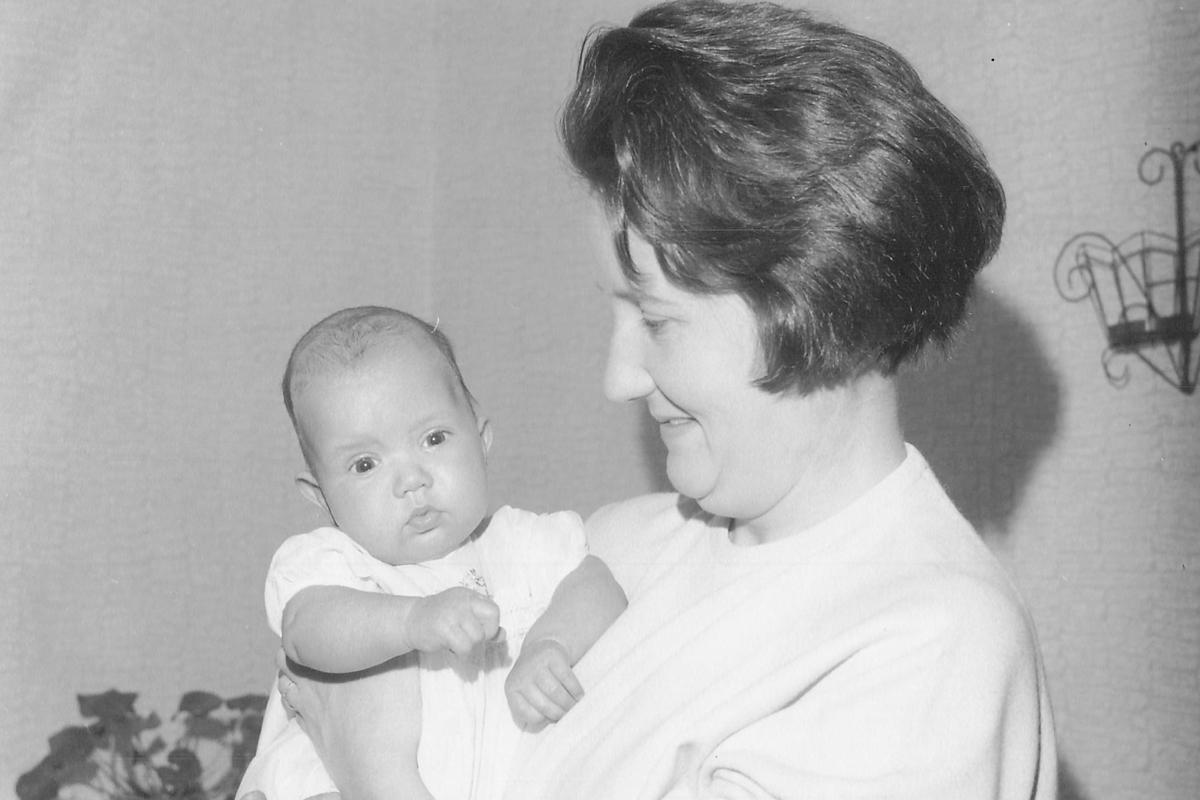
With my mother Rita (a one-legged telephonist).
The interesting part came when I started trying to work out what to put on it.
Because once I tried to tell stories rather than simply list a bunch of jobs and voluntary things, I realised that quite a lot of my career appeared to have happened entirely by accident, and that, taken as a whole, it had never made quite as much sense as I had assumed. So I started trying to puzzle it out.
I was quite good at hard sums at school and ended up studying mathematics and theoretical physics at university. I then became a software engineer, moved into international technology management, discovered law, did another degree or two and some academic research, wrote half a bestselling textbook, entered judicial and public service, helped establish a school and somehow accumulated a succession of roles in charities and civil society along the way.
Written down like that, it does look rather as though I have spent most of my professional life wandering from one thing to another. And, for a long time, that was more or less how I thought about it. Each step made sense at the time; what I had never really done was stand back and ask whether the steps made sense together.
Building this site made me do that.
And it turns out that I think they do. Retrofitting a logical structure over everything, it seems I’ve always been interested in systems: how they work, what rules govern them, what happens when they fail and, for the ones with people in them, how those people make decisions inside them. Physics, software, law, governance and public service may look like very different worlds, but each has its own structures, rules and constraints. I do like a rule, as it happens. But I also quite like finding their boundaries – and stretching them from time to time as well...
The Polish immigrant and the one-legged telephonist
Before moving on, I should probably explain the parent references briefly. My mother, Rita, was born in Reading and, sadly, lost her left leg above the knee to bone cancer at the age of 13. Obviously, I never knew what it was to have a two-legged mother. Indeed, I began the eulogy at her funeral with an adaptation of the Peter Cook and Dudley Moore one-legged Tarzan skit: ‘Rita, my mother, was a unidexter. Deficient in the leg division to the tune of one. Her right leg, I liked. I had nothing against her right leg. Unfortunately, neither did she.’ (It’s what she would have wanted.)
Having missed much of her secondary education because of her childhood illness, she began work at the Post Office Telephone Exchange in Minster Street, Reading, at the age of 15. She worked there for 18 years before leaving to have me.
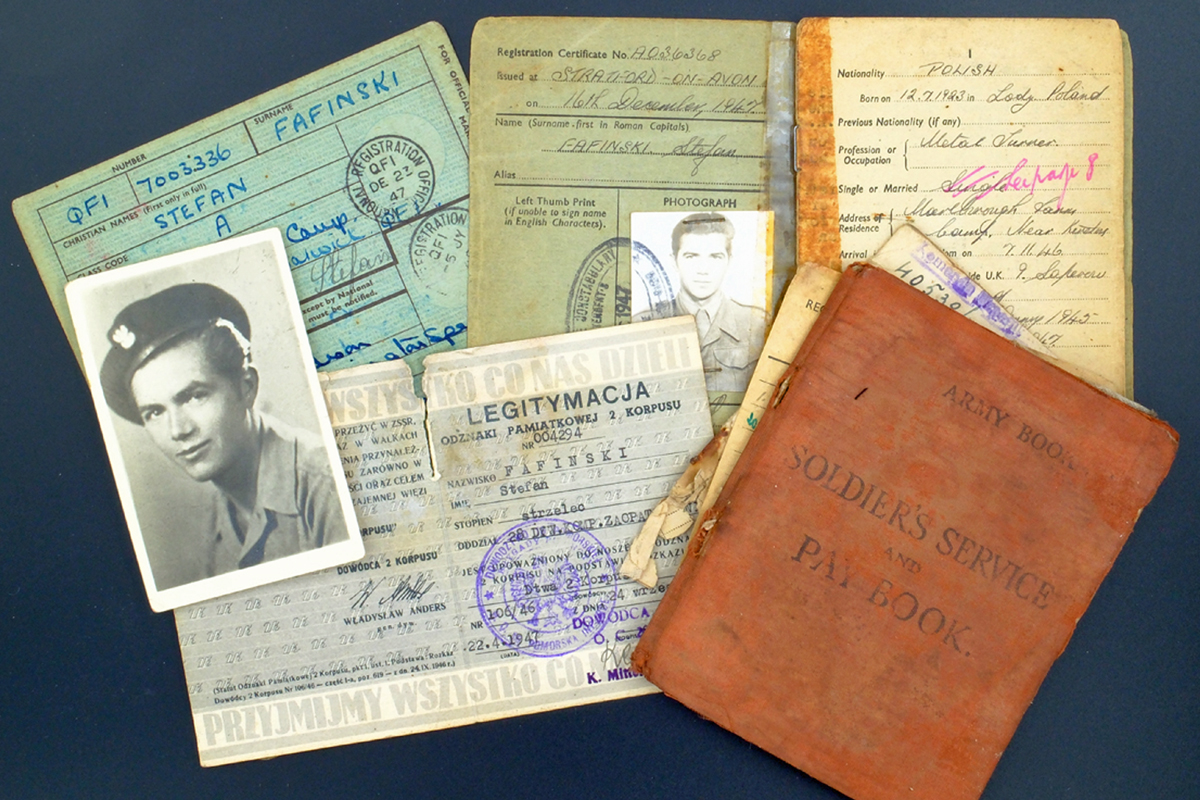
Various documents from my father's archive.
My father, Stefan Fąfiński, was born in Łódź in 1923. During the Second World War he made his way out of occupied Poland and joined the Polish Armed Forces in the West. He later served with General Władysław Anders’ Polish II Corps and was associated with the 23rd Transport Company, working as a motor driver. He spoke of his experiences at Monte Cassino, where his unit formed part of the Corps’ supply and transport organisation during the Italian campaign.
After the war he came to Britain, arriving on 7 November 1946. Like many Polish servicemen who could not simply return to the country they had left, he entered the Polish Resettlement Corps, the organisation created to help former Polish soldiers make the transition into civilian life in Britain. His surviving papers trace that process: military service, resettlement, civilian employment and, eventually, a life in Reading.
He was formally discharged from the Polish Resettlement Corps at Witley Camp on 20 January 1949. And 19 years later, to the day, I was born.
There is no significance to that beyond coincidence. But I have come to like it. One date marks the formal end of the military life that had carried my father from wartime Poland to Britain; the same date, years later, marks the beginning of mine. It is a small connection across generations - entirely unplanned, but somehow fitting in a life in which so many apparently separate strands have turned out to be connected after all.
Hard sums
As I've mentioned, I was always quite good at hard sums. That is the slightly flippant version (and I do have a tendency for that), but it is also more or less true. At Reading School, the unimaginatively named grammar school in Reading, I was drawn towards mathematics and physics because there generally was an answer, and there was usually a way of getting to it if you understood the rules properly and were prepared to think hard enough. I also had two inspirational teachers – John Barraclough and Roy Perkins – who knew exactly how to bring out the best in me.
That eventually took me to St John’s College, Cambridge to read Natural Sciences, concentrating on mathematics and theoretical physics. Looking back, I wonder now if engineering would have made more sense, but I didn’t really know what engineering was when I applied, so I just stuck with subjects I at least knew the names of. At the time I had no particular idea what I was going to do with any of it. There was no great career plan and certainly nothing involving law, public service or charity governance. I was interested in understanding difficult things and, rather fortunately, had been given the opportunity to spend three years doing exactly that somewhere really rather special.
Before I went, though, I had to have a year off. Having left Reading School at 17, I had no choice but to wait a year before going up. I started the year as many other aimless 17-year-olds might, largely loafing about and learning to play the guitar. That summer, one of my school friends who was himself going up to Cambridge at the ripe old age of 18 had been working at a new software company in Henley-on-Thames. He knew the owner and it turned out that they needed an extra pair of hands for a few days. We had spent years messing around with computers together at school and at home, so he rang me up. About an hour later, I was in the pub next door to the office meeting the owner and having a slightly underage pint. I started the following day and ended up staying for the rest of my year off, then returning in every university holiday afterwards. It gave me both money and something useful to do. On the day of my final exam at Cambridge, I found a letter offering me a full-time job.
I didn’t become a physicist. Armed with a BA in Natural Sciences, I became a mostly-self-taught software engineer instead, which in retrospect was probably less of a change of direction than it sounds.
(By the way, I know a BA in Natural Sciences sounds odd, but Cambridge doesn’t do those new-fangled BSc things. You get a BA with the promise of an upgrade to an MA a few years later provided you met the criteria which seemed to be: (a) staying alive and (b) paying the postage for the certificate if you didn’t want the hassle of going through another graduation ceremony for something that seemed a bit hollow).
Programming appealed to much the same bit of my brain: understand the system, learn the rules, break a complicated problem into smaller ones and make the thing work. The principal difference was that, when software failed, there was at least a reasonable chance that it was my fault.
Quite a lot of software failures turned out to be my fault.
People are harder to debug
I stayed in technology for about fifteen years. Quite quickly, I moved away from writing software all day and into roles involving customers and projects, then, after a couple of moves, into operations and eventually taking responsibility for teams numbering in the hundreds. By the end, I was working internationally in professional services and senior management, splitting my time between the UK and San Jose, California – the heart of Silicon Valley. That was a long way, both literally and metaphorically, from the young, untrained programmer who had wandered into a pub in Henley looking for a few days’ work. It was also really good for collecting Air Miles.
I was still dealing with systems, but by then the interesting ones were increasingly human. Software was still important, but the difficult bit was often not the technology itself. It was the organisation around it: people, incentives, competing priorities, politics, imperfect information and decisions that had to be made without knowing everything you would ideally like to know.
People, it turns out, are much harder to debug.
I enjoyed that world and did reasonably well out of it. But somewhere along the way, having spent increasing amounts of time with corporate lawyers simply because of the nature of my job, I became interested in the rules surrounding technology rather than just the rules of the technology itself: who was responsible when things went wrong, how risk should be managed and governed, how new technologies fitted within old legal structures, and what happened when the rulebook hadn’t quite caught up with what people were already able to do.
A different set of rules
So by then, I’d become law-curious. Not because I wanted to become a lawyer, but because I kept bumping into legal questions through work and wanted to understand what was going on rather than simply hand them over to somebody else. I didn’t like feeling stupid and I wanted to understand the professional advice I was being given.
One Saturday morning, I was at home doing largely nothing, when an old-fashioned paper leaflet fluttered through my letterbox. 'How about studying law with the Open University?' it said; or words to that effect. That seemed like a good idea, so while still working full-time in technology, I signed up with the OU for an LLB.
In some ways law felt unexpectedly familiar. There were rules, structures and systems again, and a requirement to think logically about how they fitted together. But there was an important difference. In mathematics, physics or software, if you understood the system well enough there was usually an answer. Law was full of situations in which perfectly valid arguments could point in entirely different directions, the facts were untidy and somebody still had to decide what to do.
Physics isn’t concerned with rights, morality or harm. It simply is. Law also had the additional vagaries of both people and language. People are unpredictable, they aren’t always truthful or honest, and language can be imprecise. It was a bit like physics with rather more uncertainty thrown in. I liked that.
(And for the physicists out there, I know that Heisenberg had an uncertainty principle too, but I was never entirely sure how it worked.)
What had begun largely out of curiosity became progressively more serious. Four years later, I found myself with a First Class LLB to go alongside my BA and postage-paid MA, and, rather than sensibly stopping there, decided to give up, or at least suspend, the day job for three years and do a PhD at the University of Leeds, which had been kind enough to offer me a full fee waiver because they thought I might have something interesting to say. My research looked at the governance of technological risk: how law and other systems of regulation respond when technology develops faster than the structures intended to govern it. The specific question was whether the criminal law could ever keep up with new cybercrimes emerging from evolving technology. The short answer was ‘no’. The longer answer was about 100,000 words and eventually became Computer Misuse: Response, Regulation and the Law.
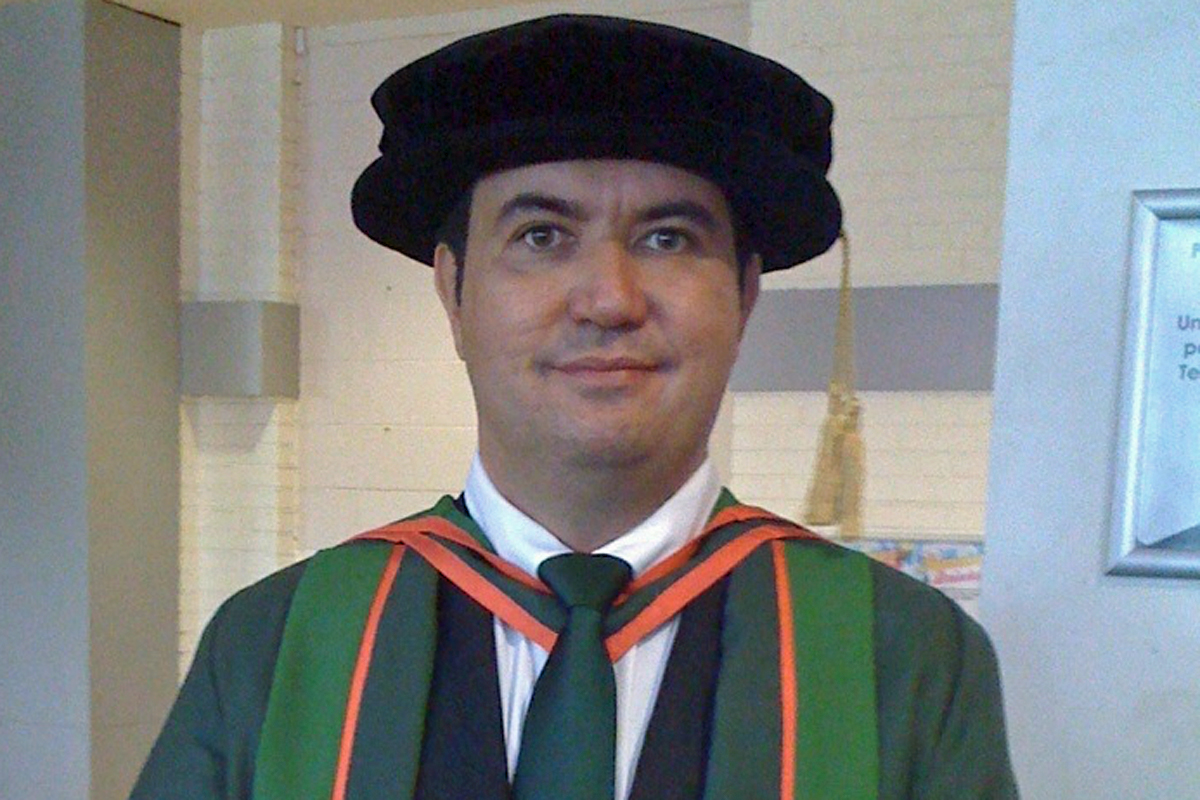
University of Leeds, PhD graduation (17 July 2009).
Looking back, that was probably the point at which what had seemed like two quite separate parts of my life finally collided. I had spent years working with technology and organisations; now I was looking at the rules around them, how those rules were made, where they failed and what happened when somebody had to exercise judgement in the gaps. So perhaps law wasn’t another change of direction after all. It was just another system.
What on earth is this all about?
Because I had been working in technology for some time, it had seemed sensible to join the British Computer Society, the profession’s main body in the UK. As well as the usual professional development events, it occasionally held social ones, including the President’s Dinner. I signed up to go in 2005.
By then, for reasons that aren’t important right now but may become obvious in a bit, I was splitting my time between Norfolk and Berkshire. The dinner was in London and, on the day, I was in Norfolk. I seriously considered not going because it suddenly seemed like an awful lot of effort. In fact, getting anywhere from Norwich is an awful lot of effort. In the end, spurred on by the thought of the cost of wasting the ticket and the prospect of a night in a nice hotel, I went.
The after-dinner speaker was introduced as the Master of the Worshipful Company of Information Technologists. I had never heard of a Worshipful Company of anything. The Master, as it turned out, was Roger Graham OBE, who stood up dressed rather as though he were the mayor of a small but well-to-do central European town, complete with fur-trimmed gown and a substantial chain of office.
I turned to the person sitting next to me and said, 'What on earth is this all about?'
'I’m actually a member,' she said. 'Would you like to find out more?' I said yes.
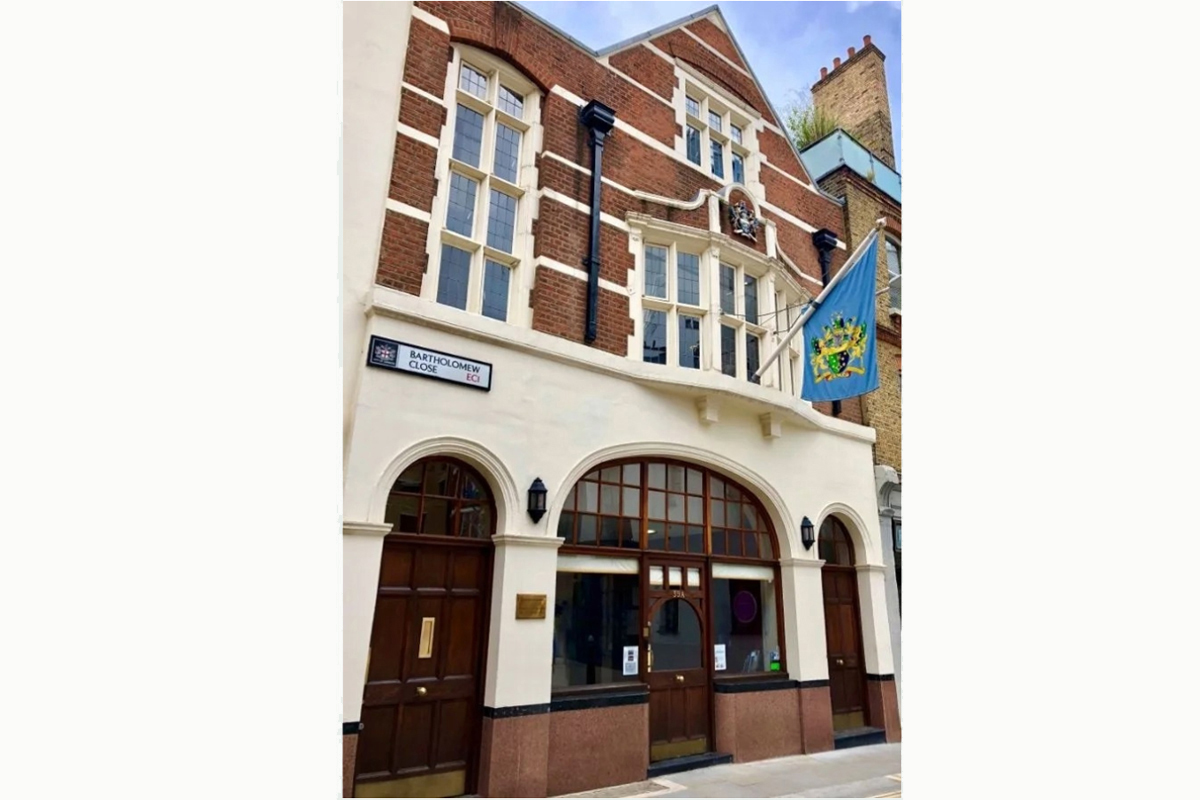
My first full encounter with a City of London Livery Company turned out to be a wine-tasting evening at the WCIT’s Hall in Bartholomew Close. I don’t remember a great deal about the rest of the evening, for obvious reasons, but I do remember coming away thinking that I would very much like to join. Looking back, deciding to go to that BCS dinner rather than staying at home was probably one of the most consequential small decisions I have ever made.
Well, that escalated quickly
I did join. And things escalated rather quickly after that.
One of the things that attracted me to the WCIT was that it wasn’t simply a dining club for people who worked in technology. Behind the gowns, dinners and slightly unfathomable City traditions was a serious commitment to using technology and the experience of its members for public benefit. Education was a particularly important part of that.
Not very long after I joined, I found myself as a WCIT sponsor governor at Lilian Baylis Technology School, and also becoming involved in plans for a new school in west London. This was in the early days of the academy programme, and the idea was to create a school with particular strengths in technology and the creative and digital industries, backed by the WCIT and the Mercers’ Company. It eventually became Hammersmith Academy.
This was rather different from anything I had done before. We weren’t talking about improving an existing organisation or advising somebody else what to do. We were helping to create an institution that didn’t yet exist: forming the trust, working through governance, buildings, funding, educational vision and all the other things that have to happen before somebody can eventually unlock doors that also don’t yet exist and let loads of children in to be taught by teachers who haven’t yet been hired under the leadership of… you get the picture.
I became one of the Academy’s co-founders, served as a director of the trust from its early days and later as a sponsor governor. And, somewhere in the middle of all this, I was also still supposed to be doing a PhD.
The project took several years and involved far more than I had imagined when I first became involved. It was my first real experience of the difference between just having a Very Good Idea and building all the things that allow that idea to survive exposure to reality. The scale of it was considerable. The project involved more than £35 million of capital investment, alongside a separate £1 million endowment from the WCIT Charity.
But the numbers aren’t really what I remember. What I remember is the slightly improbable process of watching something move from meetings, papers and plans, via an enormous hole in the ground and a cardboard cut-out model at the Livery Hall, into bricks and mortar, teachers, pupils and a school community with a life and ethos entirely of its own.

Looking back, Hammersmith Academy was probably where another part of the pattern began to emerge. Until then, most of the systems I had dealt with had already existed when I arrived. This was different. Here was an opportunity to help build a whole new system from scratch within the constraints of the bigger systems in which it was contained and, importantly, unlike most of the software I’d ever written, to build something intended to outlast the people who had created it.
There is something rather humbling about helping to establish an institution and then realising it doesn’t actually need you any more. That is, after all, the point. Hammersmith Academy was never supposed to be a monument to its founders. The success was that it became simply a school: an organisation with its own leadership, culture and history, educating young people who mostly have no reason to know, or indeed care about, who was sitting around tables years earlier trying to work out how to make it happen.
I think that experience changed how I thought about governance. Until then, governance had mostly meant making existing systems work properly. Hammersmith Academy taught me that governance can also be creative. Done well, it is part of the process by which an idea acquires enough order and substance to become an institution.
And, yes, it was called Hammersmith Academy because it was an academy. In Hammersmith. Reading School had clearly set a precedent for institutional naming ambition. I still think it sounds more like a music venue.
A diversion into legal education
While I was involved in creating Hammersmith Academy, another quite different strand of my life was developing in parallel. I had originally started studying law because I wanted to understand the legal issues I was encountering through my day job in technology. I had not set out to become a legal academic (and neither did I particularly want to), still less to write textbooks.
By the time I finished my PhD, I had somehow acquired two overlapping areas of interest, if not quite two careers. I was still a technologist, although increasingly interested in the systems around technology rather than just the technology itself. I was also now a lawyer, or at least somebody who understood rather more about law than I had originally intended. The obvious question was what to do with that combination.
And as usual, there wasn’t really a plan.
Around this time, a new opportunity arose through the world of legal education. A project was underway at the University of East Anglia to develop a different kind of law textbook: one that focused not only on knowing legal rules, but on developing the practical skills needed to use them. After one of the original author team stepped away, I became involved initially because of the technology. The book was intended to have online resources – still relatively unusual at the time – and my background in technology made that a natural area for me to contribute.
Then came the first meeting with Oxford University Press.
Because the book was a new departure rather than simply another 'this is what the law is' sort of thing, OUP explained that draft chapters would be sent out for review to academics in batches. This was entirely normal from their perspective: a way of testing and improving a new textbook before publication, and, perhaps, a useful way of building interest before publication.
It did not go well.
The author who had originally conceived the project, already an established academic, decided that this wasn’t the way she wanted to write a book and stepped away from the project there and then. And I nearly choked on a plain chocolate digestive.
Suddenly there were two authors left with a contract to write a book that neither of us had originally set out to create. What we did share, however, was a belief that law students needed something different: not just a book explaining what the law was, but a guide to how to study it, how to think about legal problems, how to research, write and communicate effectively, and how to develop the skills that would serve them both in professional life and afterwards.
So we wrote it.
What we didn’t know at the time was that this slightly improbable project would become something much larger. Legal Skills went on to become one of the books through which generations of law students first encountered the practical side of legal study, eventually selling more than 100,000 copies, being adopted by universities across England and Wales and now in its tenth edition (with the eleventh about to start).

Legal Skills: 1st edition (2007) and 10th edition (2025).
And then we went on to write a bunch of smaller, practical, 'this is what the law is' books anyway.
Looking back, I think it was another example of the same pattern that had appeared several times before. My background in technology turned out to be useful because this was not simply about writing a book. It was about designing a system for helping people learn: taking complex material, understanding how people use it, and creating something that allowed them to apply it effectively.
Which, although I did not realise it at the time, was not so different from everything else I had done.
Oh, and two months after the first edition of Legal Skills was published, my co-author and I got married.
This is becoming a habit
Volunteering was another strand that had been running through my life for some time.
My first proper volunteering happened while I was still working full-time in tech. At the time, I was working for Aspect Communications, which had not long before acquired me along with the rest of Envoy Systems. Aspect had the ‘Aspects of Life’ fund, which made grants to organisations supporting disadvantaged young people, and they needed another trustee.
I didn’t know much about trusteeship, but I did know that the meetings always seemed to have top-notch sandwiches. It sounded interesting and worthwhile, so I agreed and got appointed.
The sandwiches were even better than anticipated.
I also quickly discovered that the meetings involved making decisions about money that wasn’t ours, but ultimately trying to do good and make as positive a difference as we could.
That sandwich-led decision didn’t seem especially momentous at the time. But, like the BCS dinner, the OU leaflet and several other seemingly inconsequential decisions, it ended up being much more significant than I had planned. I found that I really enjoyed it, and it gave me a sense of broader purpose.
Once I’d joined the WCIT, there were many more opportunities for volunteering. Livery Companies are founded on an ethos of charity and service, and the WCIT was no exception. It had already become involved with Lilian Baylis Technology School in Lambeth, so not long after joining I became one of the WCIT Governors there. That naturally led on to the Hammersmith Academy project.
By then, I had accumulated a mixture of technology, management, law and governance experience and had found somewhere actively encouraging me to use it for things that had nothing to do with earning a living.
In 2010, I joined the WCIT Charity as a trustee.
At first, this felt like an extension of what I was already doing. Although the Charity had relatively limited funds at its disposal back then, it made small grants to organisations using technology for public benefit. Within a couple of years, I found myself chairing what was known as the Charitable Operations Committee, or ‘ChOps’, and soon came to realise that good charitable governance was really about making choices, sometimes very hard ones.
There is always more demand than there is money to meet it. Good and Worthy Projects compete with other Good and Worthy Projects. Some organisations are compelling but precarious. Others are well-established but less brave or imaginative. Sometimes a tiny grant can unlock something with a hugely transformative impact, whereas a much bigger grant might simply get sucked into a project without very much happening as a result, or certainly nothing we could point to afterwards and say, ‘our grant did X’.
The same questions kept reappearing in different forms.
What evidence do we have? What are we trying to achieve? What are the risks? What happens if we are wrong? Who benefits? Who carries the consequences? So what? What difference will this make? Does it fit with what we want to be known for?
And sooner or later, someone, or a bunch of people, has to decide.
By then, my voluntary work was becoming increasingly difficult to separate from the day job. In fact, the two fed each other. Technology experience helped with charitable projects. Legal training helped with governance. Governance helped me understand organisations better. And working with charities and voluntary organisations rather than purely commercial ones became really illuminating.
I had spent much of my earlier career helping organisations make more money more effectively.
It turned out I rather liked helping them do good things as well.
And somewhere along the way, what had begun with some excellent sandwiches was becoming something much more significant.
Someone has to decide
The volunteering started getting serious. I continued to be involved with the WCIT more generally as well as via the Charity. I spent some time on the Education and Training Committee (for obvious reasons) and also established a Law and Technology Panel (the WCIT calls its interest groups ‘panels’) which did some interesting things for a few years. In parallel with this, I continued chairing ChOps.
Livery Companies have quite a hierarchy. In short, everyone joins as a Freeman but can then, if they contribute over time and have been granted Freedom of the City of London, get invited to become a Liveryman (essentially ‘full membership’). I got elevated to Liveryman a couple of years after starting on the Hammersmith Academy project. Shortly after that I got invited to join the WCIT’s governing body (known as the ‘Court’) as a Court Liveryman. This was a two-year appointment, at the end of which I was asked to stay on as a Court Assistant. It was then that it dawned on me that there was a possibility of progressing to become Master in due course. In other words, I’d somehow gone from turning up to a wine-tasting because I was curious about the man in the fur-trimmed gown at a dinner I almost didn't bother attending to becoming one of the small group of senior members expected, in the ordinary course of things, eventually to wear the fur-trimmed gown for themselves.
This had not been part of the plan. In fact, there still wasn’t a plan.
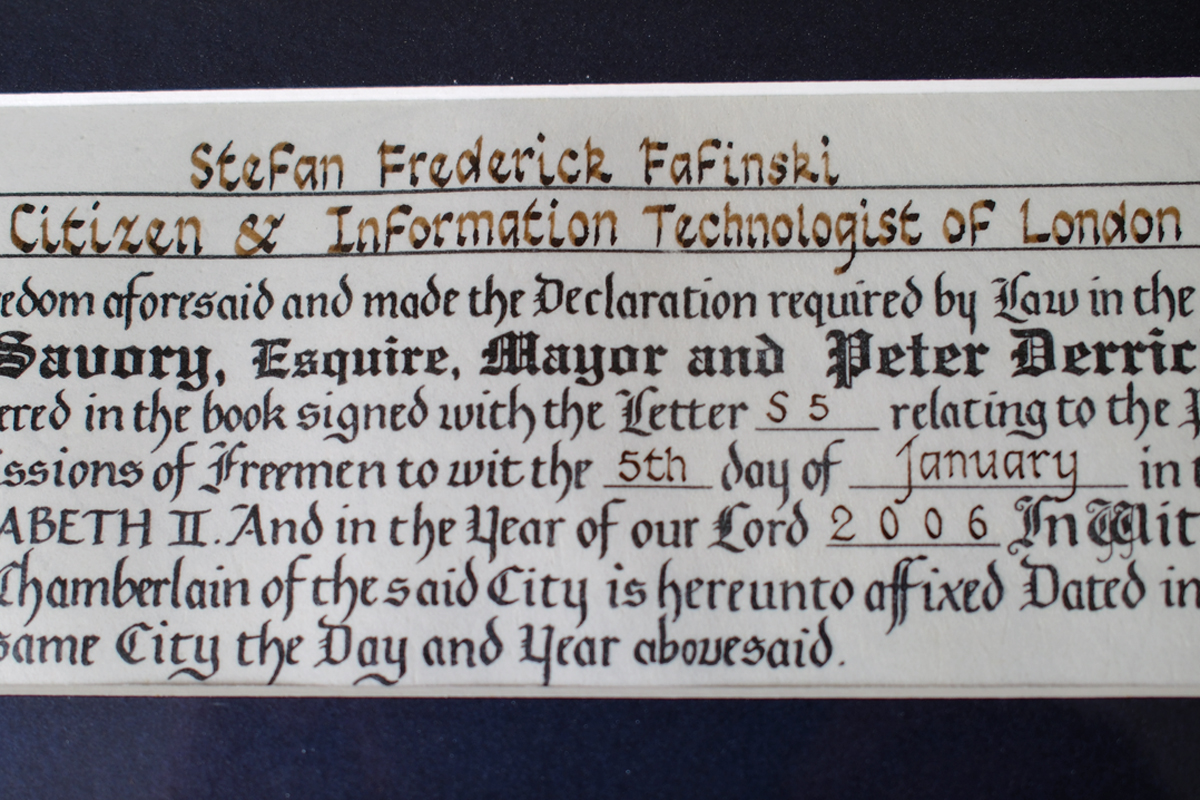
Freedom of the City of London as a ‘Citizen and Information Technologist’ (5 January 2006).
My working life was also changing. Law, writing and education had become a much bigger part of it, while the technology career that had started almost by accident in Henley was gradually receding into the background. I was still interested in technology, but increasingly through the systems surrounding it: governance, responsibility, regulation, evidence, risk and the way people made decisions when there wasn’t an obvious answer.
Then came another OU leaflet moment. As part of the continuous research to make sure I was current on the law, I subscribed to a daily legal updates service. And through this, I discovered, sometime in late 2015 or early 2016, that the Parole Board for England and Wales was recruiting.
Of course, I knew broadly what the Parole Board did. It’s an independent body which makes decisions about whether certain prisoners can safely be released, applying a legal test to evidence about risk, behaviour, change and the arrangements proposed for managing somebody in the community.
But I’d never previously thought, 'What I really want to do next is make decisions about whether people are safe to come out of prison.' That would have been an extremely niche ambition.
It sounded fascinating. There was law, obviously, but also evidence, psychology, risk assessment, competing professional opinions, human behaviour and uncertainty. There was a formal decision-making framework, but the framework couldn't make the decision for you.
That was quite a familiar feeling by now, so I applied, and, after a very long process, including a terrifying final assessment and interview at the Ministry of Justice, was appointed to start in July 2017.
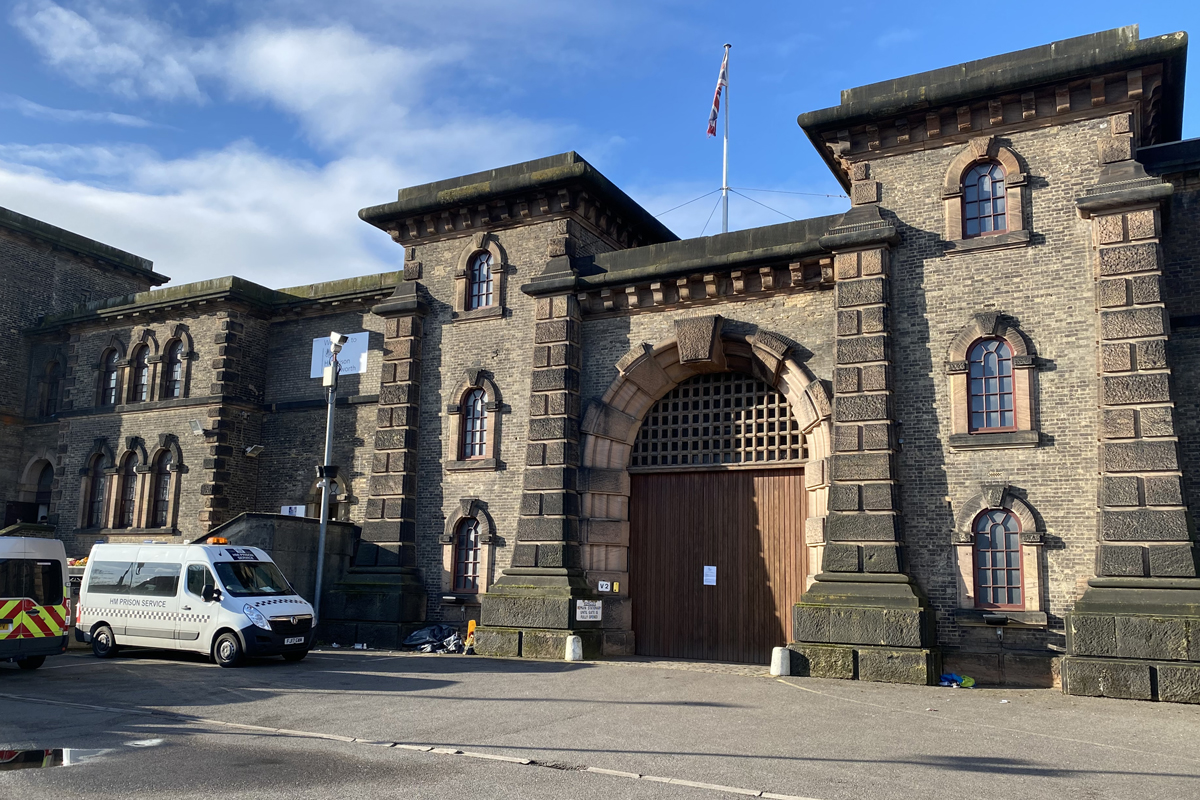
Looking back, I can now see that quite a lot of what I had done previously had been preparing me for the world of parole, although I had certainly not understood it that way at the time. Hard sums and science had taught me to look for structure and evidence. Software engineering had taught me to break complex problems down into component parts and apply logic to solving them. Management had taught me that systems involving people rarely (that is to say, never) behave quite as consistently and predictably as the ones involving computers. Law had taught me that two ostensibly sensible arguments could go in opposite directions. My PhD had been all about technological risk and what happened to those risks when existing legal and regulatory systems struggled to keep pace with uncertainty. And charitable governance reinforced one more thing: there is very rarely enough information to make a perfect decision.
The Parole Board put all of that into a rather more consequential setting. Only this time the decisions were about people.
A parole review isn’t an exercise in predicting the future with certainty, because nobody can do that. It is an assessment of risk based on the evidence available now. The panel may hear from probation officers, prison staff, psychologists and other professionals. There may be detailed written assessments, years of records and competing interpretations of the same behaviour. The prisoner may disagree strongly with some of it, or indeed all of it. Lawyers make submissions about what the evidence means or how the evidence shows that the legal test is met and their client should be released.
Sometimes professional witnesses agree. Often they do not. And at the end of the hearing the panel still has to make a decision.
Unless it doesn’t, of course. There is a natural temptation, whenever a decision feels difficult, to adjourn for one more report, one more assessment or one more piece of information which will somehow make the answer obvious. Sometimes, of course, more evidence really is needed. But sometimes asking for more information is simply a more respectable way of postponing the uncomfortable fact that the available evidence has to be weighed and somebody has to exercise judgement.
Judgement isn’t the same as instinct, and it’s certainly not a licence to do whatever feels right. It has to be disciplined by the law, the evidence and the reasons you can give for the conclusion you reach. It’s also not a mechanical process. There is no spreadsheet into which you can enter the number of courses completed, positive reports, negative incidents, protective factors and risk factors and have the 'correct answer' appear in a green (or red) box at the bottom. Yes, there are structured assessment tools used by professional witnesses to assess risk. But if it were simply a matter of trusting those tools, there would be no need for humans to make decisions at all.
While this was mildly disappointing to the former software engineer in me, I’d also introduced enough bugs in my early career to be relieved that there was still a place for judgement and trying to understand what the evidence actually tells you. Has somebody changed, or simply learned the language of change? Does a professional assessment rest on evidence that can withstand scrutiny? Is an apparent inconsistency important or merely human error? What would happen if a particular part of a risk management plan failed? How much weight should be placed on conduct in a highly structured environment when the question concerns behaviour outside it? And, perhaps most importantly, what don’t we know?
And once you’ve made that decision, you have to explain it. In a way that withstands very close scrutiny indeed. A prisoner is entitled to understand why a panel has reached its conclusion. The professionals involved need to understand the reasoning too, while victims and the wider public are entitled to confidence that decisions affecting liberty and public protection have been made carefully and lawfully.
For years I’d been (co-)writing textbooks which tried to take complicated legal material and explain it clearly. Now I was doing something quite different in purpose, but oddly similar in method: take a large body of information, identify the important bits, apply the relevant rules and explain the result in language another human being can actually follow. Clear enough for a non-specialist reader, and simultaneously robust enough for the lawyers out there.
The parole work also changed the way I thought about fairness.
Sometimes, there have been cases where my instinctive reaction has been, 'but he/she hasn’t served enough time for that'. But that isn't the test, so I have to park the innately human response and go back to the evidence. I have directed release when part of me would rather not have done, and refused release when I very much wanted to give someone a chance in the community.
Over time, the work became an increasingly important part of my life, and it still is. I moved from learning how the Board worked to taking on greater responsibility within it, chairing hearings and dealing with increasingly complex decisions. But the basic questions remained the same: what evidence do we have? What does it tell us? What are the risks if it all goes wrong? Who has to decide this?
By now, more often than not, the answer to the last question was me.
This was an interesting development for someone whose career plan at 17 had consisted mainly of playing guitar and seeing what happened next.
And while I was getting going with the Parole Board, I’d moved on up and become the Senior Warden at the WCIT. Very shortly, I was going to dress up like a well-to-do central European mayor myself.
Wearing the fur-trimmed gown
Eventually, it happened. I became the man in the fur-trimmed gown.
In October 2017, I became Master of the Worshipful Company of Information Technologists.
The Master serves for a year and is essentially part chair, part ambassador, part host and part representative. There are dinners and ceremonies, certainly, but the office is really about bringing people together and trying to leave the organisation slightly better than you found it. There isn’t enough time to do much else.
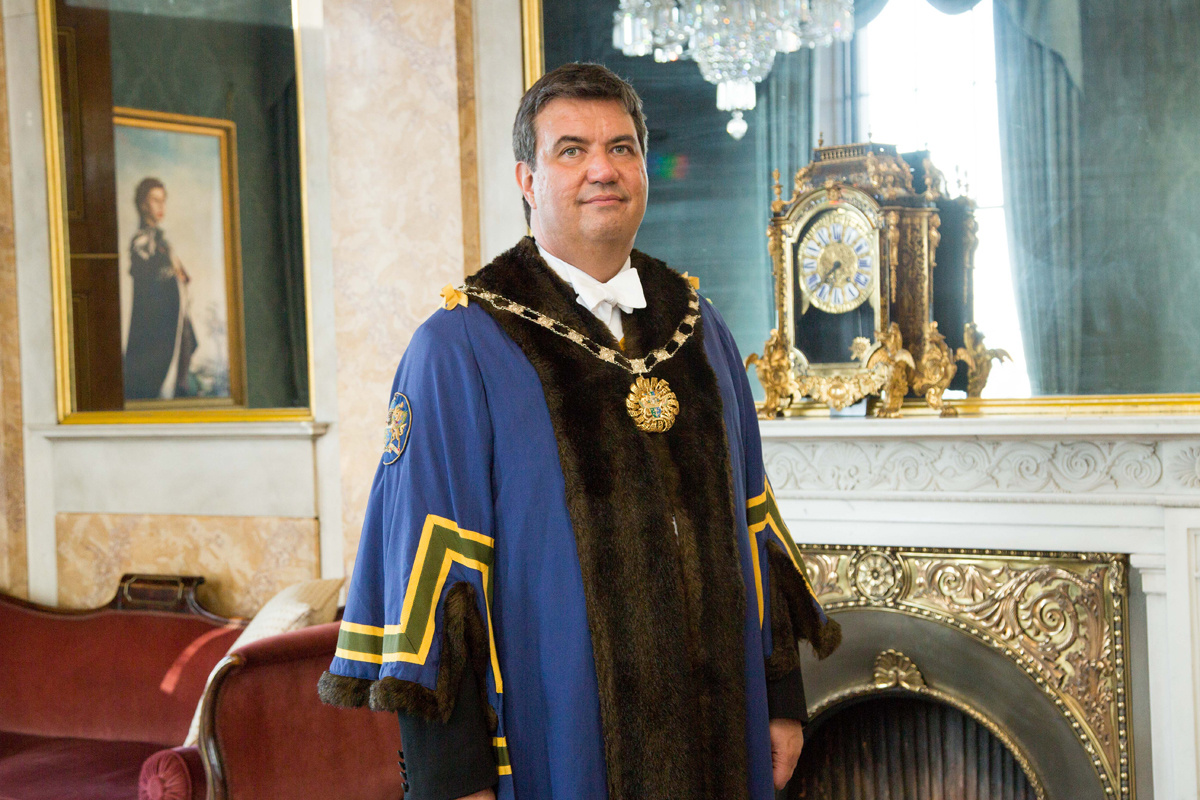
As Master of the WCIT (Fishmongers' Hall, 11 July 2018).
There was also something wonderfully incongruous about being Master of an organisation concerned with information technology while operating inside a system of governance, ceremony and civic life that had evolved over centuries. We talked about artificial intelligence, cybersecurity and digital skills, sometimes while wearing gowns and badges of office in rooms containing portraits of people who had died long before electricity was a thing.
By then I had spent years working with the Company, the Academy and the Charity, so becoming Master didn’t feel like something entirely new. But it did change my perspective – although you may think you know how the Company works, it is really only on becoming Master that everything begins to join up and make a bit more sense. Being on a committee or governing body allows you to concentrate on a few discrete and particular questions. But being the person at the front means having to think about the whole organisation, its people, its relationships, its reputation, its traditions and, fundamentally, what it’s there for in the first place.
More importantly than all that, it makes you realise how little can be achieved by the overdressed person at the front acting alone.
A Livery Company is a peculiar collection of people. In our case, members join from different generations, careers and parts of the industry, with different reasons for joining and different ideas about what the Company should be doing. So, it’s part of the Master’s job to create enough common purpose that people with different interests can contribute usefully to something larger than themselves in a way that works for them.
There is also a particular kind of responsibility that comes with representing an institution publicly. You discover very quickly that, while people may be speaking to you, they are often really speaking to the office you temporarily occupy. The invitation arrives because you are Master. The seat at the table belongs to the Master. The gown belongs to the Company. Eventually somebody else will wear it.
The year also brought together several strands that had been developing separately. Technology was still there, obviously. So were education and the Academy. The charitable work mattered increasingly. And I was now beginning my work with the Parole Board at the same time, moving between environments that could hardly have looked more different but which, underneath, involved surprisingly similar questions about judgement, responsibility and institutions.
One particularly important part of the WCIT world was the Charity. I had necessarily stepped away from its Board while in the run-up to becoming Master, but I had already spent several years involved in its grant-making and had seen both what relatively modest amounts of money could achieve and how frustrating it was when the resources available did not match the quality of the ideas coming through the door.
During my Master’s year, that thinking began to become more ambitious.
In 2018, the WCIT Charity made two unusually large awards, of £300,000 each, to CALM and Missing People. Both were intended to help charities use artificial intelligence to tackle very different social problems. These were not ordinary grants by the standards of the Charity at the time. They were bigger bets, built around the idea that technology could be used not simply to make an organisation more efficient, but to facilitate a step change in what it was capable of doing. Those awards turned out to be the beginning of something much larger.
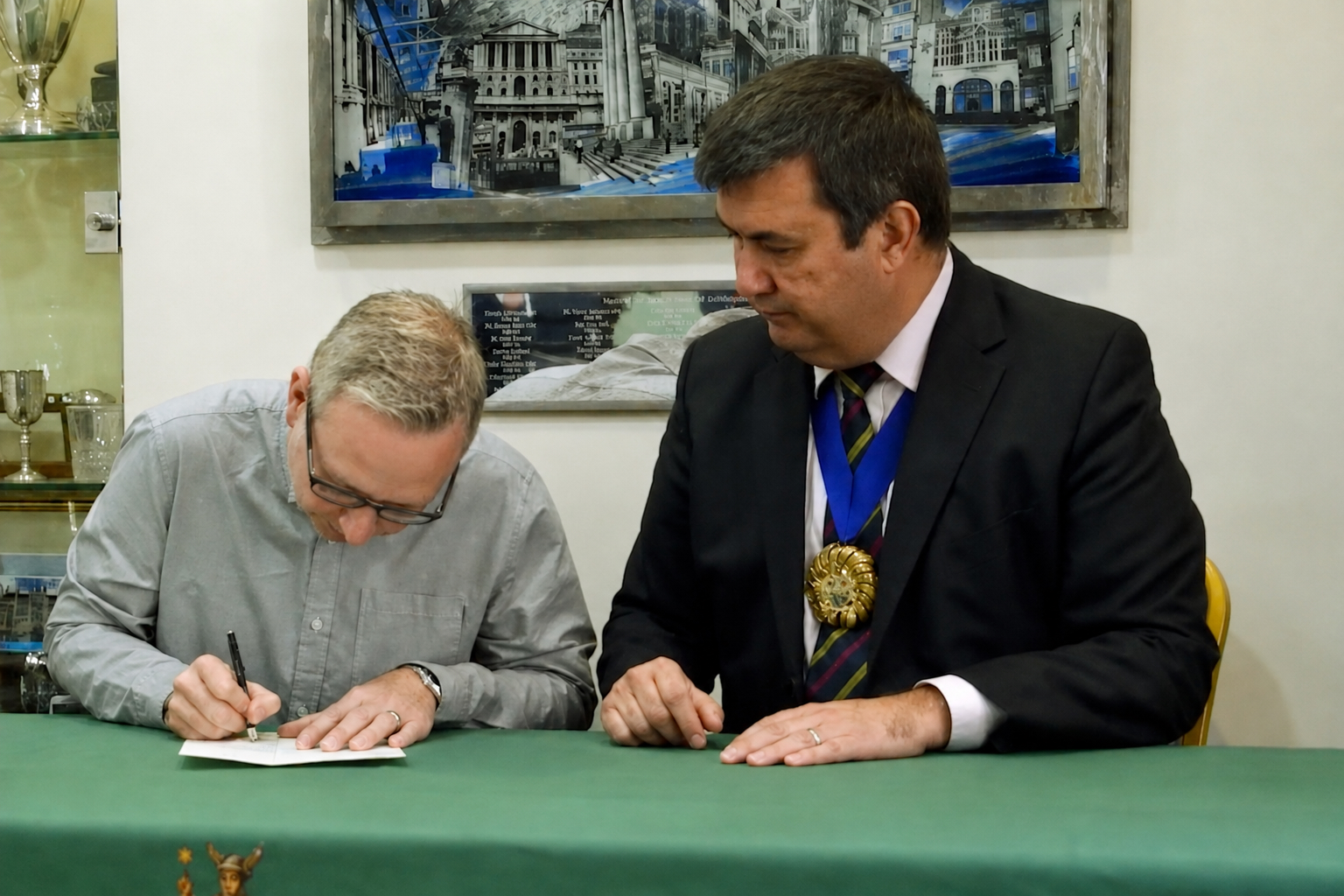
Signing the WCIT Charity Award grant agreement as Master with Simon Gunning, CEO CALM (WCIT Hall, 4 October 2018).
The year ended, as years do. My dear friend Lady Parmley (Wendy), who had joined around the same time as I did and with whom I had worked incredibly closely at Hammersmith Academy, took the gown, the badge and the seat at the table. I became Deputy Master, which is essentially a licence to offer advice that may or may not have been requested.
And then, very shortly afterwards, I found myself back where I had started much of this particular journey: with the WCIT Charity.
Only this time, I was going to be its Chair.
Giving it away is easy
I rejoined the WCIT Charity Board in early 2019 and, not long afterwards, became Chair.
By then I had known the Charity from several different angles. I had been a trustee, chaired ChOps, helped assess grants and, during my year as Master, seen what happened when we were prepared to make much bigger commitments. I also knew its limitations. There were always more good ideas than money, and the difficult part was rarely finding worthwhile things to support. It was deciding which of them might make the greatest difference.
I had spent enough time around charities to know that giving money away is surprisingly easy. Giving it away well is much harder.
The 2018 awards to CALM and Missing People had already pushed the Charity towards thinking differently. They were large by our standards, deliberately ambitious and based on the idea that technology could create a step change rather than simply improve an existing process around the edges. They also raised another question. If charities were starting to use artificial intelligence in serious ways, could they learn from one another – and if so, how?
That question eventually led to what became AI4C, originally a fairly modest but deliberate attempt to bring charities together to share their practical experience of using AI. It grew directly out of the 2018 awards, with CALM and Missing People willing to talk openly about their own projects. What seemed to be missing was somewhere charities could talk honestly about what they were actually doing, what worked, what didn’t and what they wished somebody had told them before they started.
It took off and, like many of the best things I’ve been involved with, it grew because other people picked it up and made it better. By the time I eventually left the Charity, AI4C had developed into a network involving approaching 100 charities and had acquired a life well beyond the original idea.
My job as Chair was not to have all the ideas. It was to help create the conditions in which good ideas could be robustly tested, attract support, be funded properly and then, ideally, become less dependent on the person who first suggested them. So we became more deliberate about strategy.
Rather than seeing the Charity simply as a pot of money from which grants emerged, we thought harder about what made us distinctive. There are many charities capable of making grants. Far fewer have access to a community of people with deep experience of technology who are willing to give their time as well as their money. That combination of funding and expertise became increasingly important.
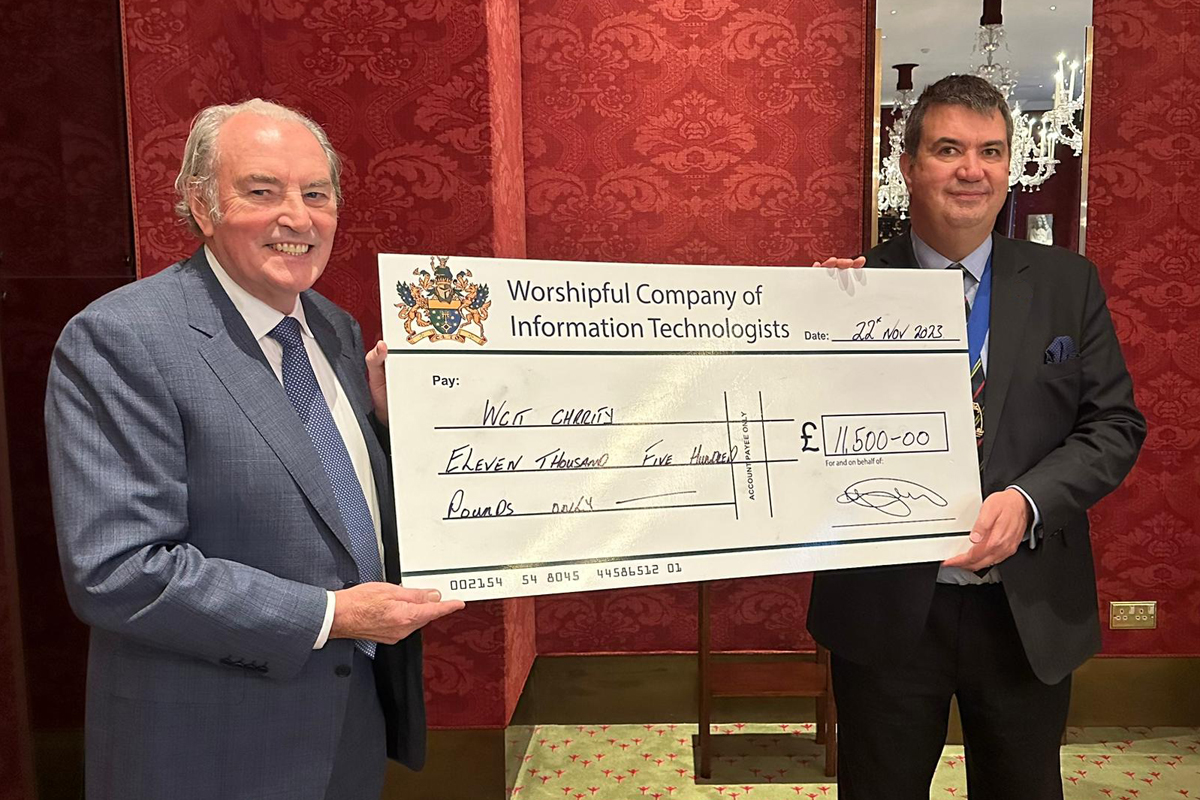
Receiving a cheque from John O'Connell on behalf of the Enterprise Awards 2023 (Grocers' Hall, 22 November 2023).
We also became more interested in leverage. A grant might matter because of the amount itself, but sometimes the more interesting question was what else it made possible. Could it unlock other funding? Could it allow an organisation to test something others might then adopt? Could a piece of work be shared? Could members of the WCIT contribute expertise alongside the funding?
Over time, the Charity’s capacity grew and so did the range of what it could support. Some programmes were long-running, such as the Gresham Professorship in Information Technology. Others emerged later, including the National Young Coders Competition and PhD bursaries. Project Pathfinder, developed with members of the WCIT’s Financial Services Technology Panel, explored how technology careers in financial services could be made more visible and accessible.
There were also hundreds of individual grant applications, ranging from small organisations seeking relatively modest sums to much larger proposals requiring difficult choices about risk, ambition and evidence.
But although the scale changed, the underlying problem was still the same. There was never enough money to fund everything that looked worthwhile.
One of the less glamorous truths about charitable leadership in a grant-making organisation is that a great deal of it involves deciding which Good and Worthy Thing will not be funded so that another Good and Worthy Thing can be. Applicants naturally tell you why their project matters. Trustees have to ask a different question: compared with everything else in front of us, does it matter enough?
Over the years, the Charity became larger, more strategic and more confident about the kind of difference we wanted to make. We funded projects, supported research, connected charities with technologists and became more open about what we were doing and why. Some of the work was visible. Much of it was not.
And somewhere along the way I realised that this was another version of the same pattern I had encountered elsewhere. A school is not really the building. A charity is not really the grants. An organisation is a system of people, decisions, incentives, relationships, processes and purpose. If those things work well together, useful things happen. If they do not, even quite a lot of money can achieve surprisingly little.
I remained Chair until the end of 2025, when the governing document required me to retire. It would probably have been sensible for me to go around then anyway.
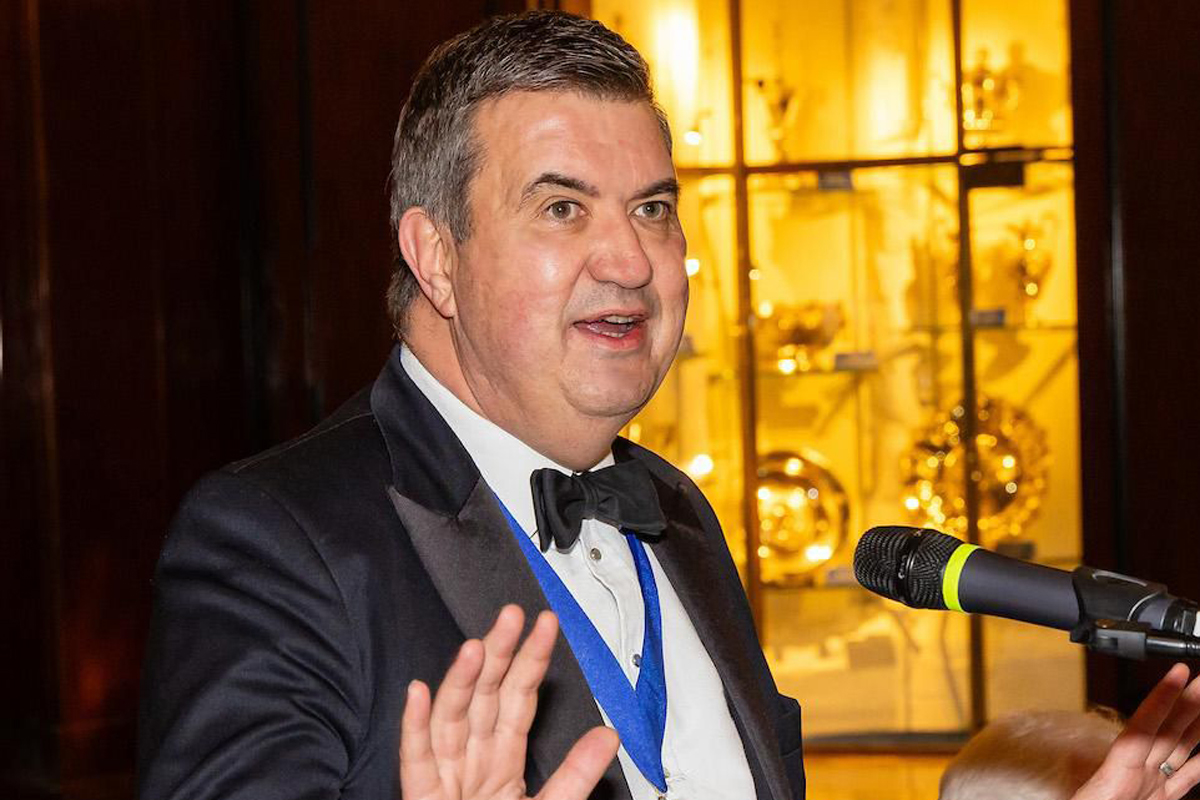
My final New Freemen's Dinner speech as Chair of WCIT Charity (Merchant Taylors' Hall, 17 January 2025).
There was a significant part of me that didn’t want to let go. But by the time the end was in sight, I was much more interested in whether the organisation would continue to work well without me than in anything it had done while I happened to be leading it. Programmes had developed their own leadership. New trustees had joined. Processes were established. New ideas were still emerging. Someone else could take over, make different decisions and take the Charity in directions I might not have chosen, without having to rebuild everything from scratch.
That felt like a much better test of whether I had done the job properly.
And by then, three more strands of my voluntary and public life had begun to develop somewhere much closer to home in Berkshire.
One thing was about to lead to another.
Back home
By this point, a lot of my work and voluntary life had been happening somewhere else: mostly in the City and prisons all over the UK. Yet Berkshire had been home for most of my life.
What I had not appreciated at first was that even these new Berkshire connections had roots in things that had happened years earlier. Once again, people, institutions and ideas from one part of my life were quietly reappearing in another. They also brought me closer to two very different communities whose vulnerability can make the quality of the institutions around them especially important: autistic young people with high levels of need, and people leaving prison.
A different kind of institution
The first of those connections was Prior’s Court.
I had known Dame Stephanie Shirley for some years through the WCIT. Steve, as she preferred to be called, was Master of the WCIT in 1992/93 (wearing the same gown I wore 25 years later), a pioneering technologist and philanthropist, and someone whose thinking about technology and public benefit had influenced the WCIT long before I joined it.
Through the Shirley Foundation, she gave £5 million to the WCIT in 1998: £1 million towards the Company’s Hall (venue for the wine-tasting) and £4 million to its charitable trust. That £4 million underpinned the WCIT Charity I would much later come to chair.
At around the same time, Steve was developing another idea altogether.
Her son Giles was autistic with high levels of need, and much of her philanthropy grew from her experience of trying to secure the right education and support for him. In 1997, a visit to the Boston Higashi School in the United States had shown her a highly structured approach to supporting autistic children and young people which made a lasting impression. She came away convinced that something comparable should exist in the UK.
That idea became Prior’s Court.
There is something rather striking, looking back, about those two strands developing at almost the same time. Steve was thinking about how philanthropy could do more than simply transfer money, using expertise and networks to multiply its effect. At the same time, she was creating a specialist institution intended to transform the lives of autistic young people and their families, and to survive long after its founder had ceased to be involved.
Years before I knew her, she had therefore already helped shape two institutions which would eventually become significant parts of my own life.
I came to know Steve properly through the WCIT. During my year as Master in 2018, we were still part of the same slightly peculiar Livery world, and over time I came to value her combination of clarity, impatience with nonsense and absolute focus on getting useful things done.
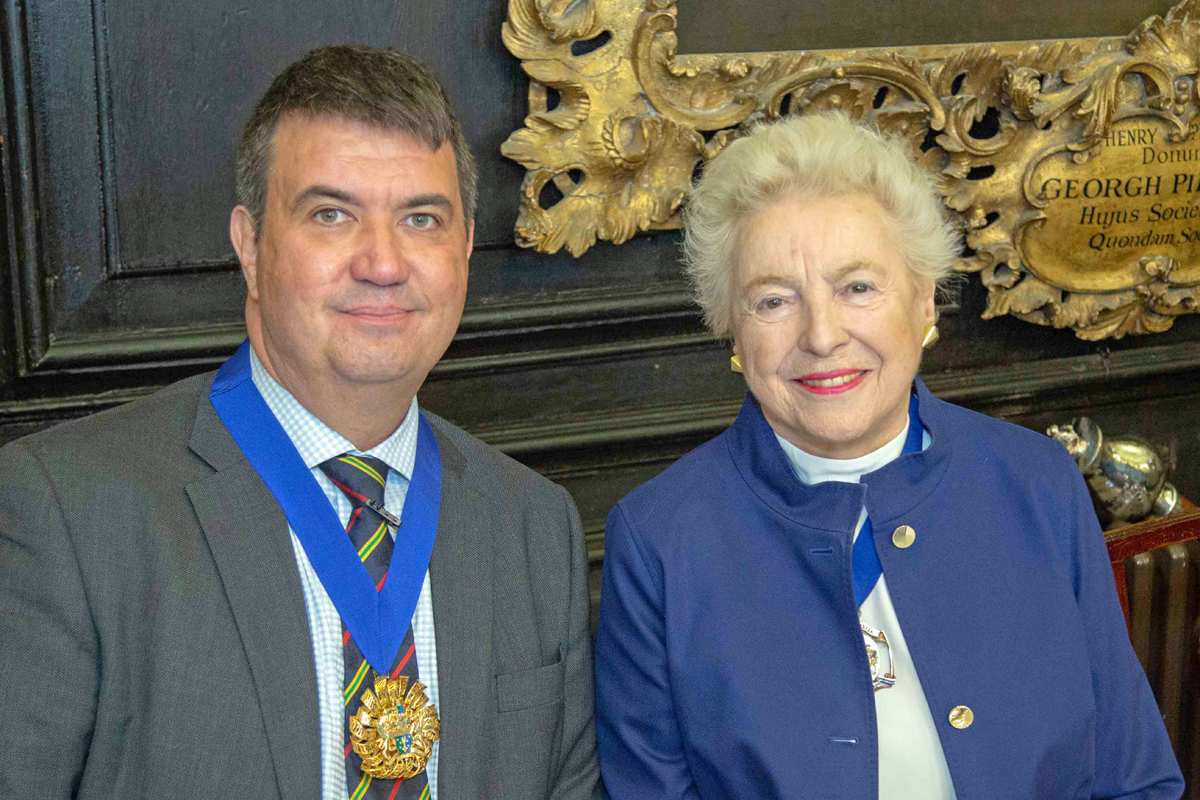
With Dame Stephanie (Steve) Shirley CH, WCIT 100th Business Lunch (Apothecaries' Hall, 16 May 2018).
A few years later, she asked me if I would consider joining the Board of Prior’s Court.
So I did. Steve was not a woman you could easily say ‘no’ to.
I became a trustee in 2022 and arrived knowing relatively little about specialist autism provision. By then, however, I’d become accustomed to joining organisations without assuming I was the subject-matter expert. Trustees are not there to tell teachers, therapists or care professionals how to do their jobs. They are there to understand enough to ask useful questions, provide challenge where it is needed, support the people doing the work and make sure that the organisation remains focused on why it exists.
Prior’s Court is an unusually complex organisation. It provides specialist education and residential care for autistic young people with high levels of need. Education, care, safeguarding, health, workforce, finance, property, regulation and family relationships all have to work together around people whose support is necessarily highly individualised.
In other words, another complicated system involving people.
The setting was different, but the disciplines were familiar: understanding risk, asking difficult questions, distinguishing genuine assurance from reassurance and thinking hard about the consequences of decisions made at Board level.
Over time, I became increasingly involved and, at the beginning of 2026, became Chair of the Board.
That was not something I could have imagined when I first met Steve through the WCIT. But by then I was getting used to the fact that apparently separate parts of my life had a habit of finding one another eventually.
Representing home
Another Berkshire strand began in 2023, when I was appointed a Deputy Lieutenant of the Royal County of Berkshire.
I had already spent years around civic ceremony through the City of London and the Livery, so some of the outward trappings were familiar. But the Lieutenancy is a rather different form of service.
It sits somewhere between national institutions and local communities. There are ceremonial duties, certainly, but much of the role involves meeting people who are doing useful things across the county: volunteers, charities, businesses, schools, faith groups, cadets, veterans and community organisations of every imaginable kind. The Lieutenancy is also heavily involved in supporting citizenship ceremonies and in assessing local charities nominated for the King's Award for Voluntary Service.
It gave me an entirely different view of a county in which I had lived for decades.
You can know the towns, roads and institutions of a place without necessarily understanding the network of people who quietly hold much of it together. The Lieutenancy introduced me to many of them.
There is also something useful about a role in which your job is often not to chair anything, decide anything or improve anything.
You simply dress up and turn up. You listen. You recognise what somebody else has done. You help mark an occasion. You say thank you on behalf of the Lord-Lieutenant and the King.
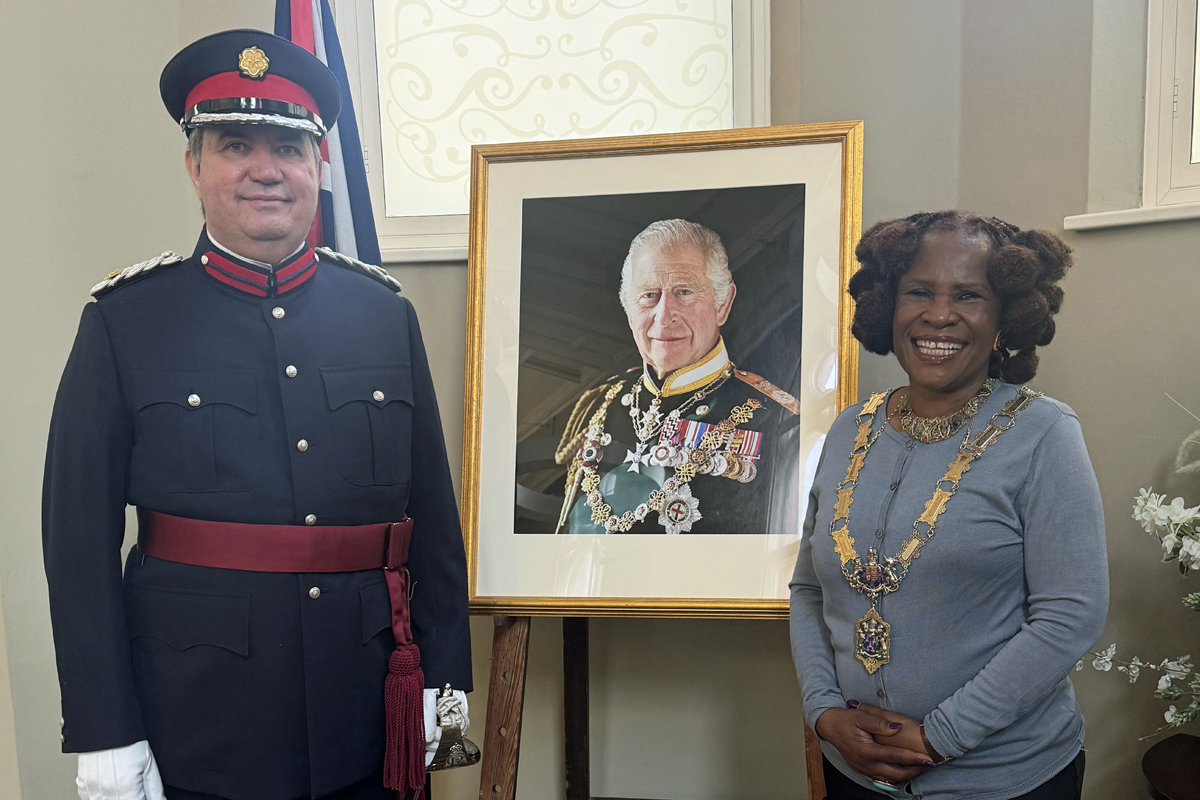
With Dr Alice Mpofu-Coles, Mayor of Reading, after a citizenship ceremony (Reading Town Hall, 8 April 2026).
Although the Livery had taught me something about institutions, continuity and representation, the Lieutenancy took those things and brought them back home.
For someone who had spent much of his career travelling elsewhere to do things, there was something very satisfying about that. And fewer trains.
They say things come in threes...
The third Berkshire strand began, appropriately enough, through another apparently unrelated conversation.
Around the same period that my Parole Board work was becoming increasingly important, I had also joined the Family Court as a magistrate and eventually sat as a Presiding Justice. Family work was different from parole, but again involved applying a legal framework to difficult human circumstances, weighing imperfect evidence and making decisions with significant consequences.
One of the people who interviewed me for the Bench had been particularly interested in what I got up to at the Parole Board.
I thought little of it at the time.
Some time later, she got in touch and asked whether I would consider joining the Board of the Inside Out Trust, of which she was Chair.
The Trust works with people on supervision in the community, helping with the practical realities of resettlement. That immediately connected with a world I knew from the Parole Board, but from a completely different perspective.
Parole decisions inevitably involve discussion of risk management, accommodation, employment, relationships, support and the arrangements that will exist after release. The Inside Out Trust brought me closer to what some of those apparently tidy words can mean in practice. People leaving prison can be particularly vulnerable at the point of release, when apparently ordinary practical problems can quickly become serious barriers to resettlement.
A person may need identification. Clothes for an interview. A phone. Help travelling somewhere. Something basic for a new home. A relatively small amount of money at exactly the right moment. None of those things sounds particularly dramatic. But real lives often turn on undramatic things.
I joined the Trust as a trustee and later succeeded the person who had first interviewed me for the Family Bench as Chair.
So a conversation about one form of public service, during an interview for another, had somehow led to a third.
After a few years, the demands of the Parole Board became increasingly substantial. So much so, that I could no longer give the Family Bench the time and continuity it deserved. I eventually stepped down. Family work requires regular sitting, keeping properly current and making a genuine contribution to the Bench. Trying to hold on to a role simply because I valued it would not have been fair to the institution or, more importantly, the people appearing before it.
Letting go of things, I was discovering, is also part of public service.
The Parole Board had taught me a great deal about risk, rehabilitation and the difficult transition from custody into the community. The Inside Out Trust brought me closer to the practical reality beneath those concepts. Prior’s Court and the Lieutenancy connected different parts of my public and voluntary life back to the county which has always been my home.
Three very different roles.
All back home in Berkshire.
And, by then, that no longer seemed quite as accidental as it once might have done.
What counts as exceptional?
My involvement with the honours system also began through the Lieutenancy.
At one of our Away Days, we had a presentation by someone from the Cabinet Office on how the national honours process works. That was useful in itself, because Lieutenancies are often asked for views on individual nominations in the county and it helped us understand what makes a good nomination and how cases were assessed.
At the end, almost as an aside, he mentioned that applications were open for independent members of the Community and Voluntary Service Honours Committee. I had already really enjoyed the King’s Award for Voluntary Service work through the Lieutenancy, so I applied, and, following the customary very long Civil Service wait after interview, was appointed.
The CVS Committee, as its name suggests, looks at nominations concerning people whose contribution falls under the very broad heading of community and voluntary service. That sounds straightforward enough until you see the strength, volume and range of the cases.
Almost all nominees have done remarkable things. Some have given decades of service. Some have founded organisations, transformed communities, supported vulnerable people, raised substantial sums, led national campaigns or sustained institutions over very long periods. So the challenge is not simply to decide whether someone has done something good. It is to assess what is genuinely exceptional and worthy of national recognition.
Strong nominations usually show clear impact, sustained contribution, evidence of service beyond the normal expectations of a role, and outcomes that can be independently supported.
The phrases ‘above and beyond', 'more than the day job' and ‘the extra mile’ are often used in discussions about honours, and it is easy for those 'criteria' to become clichés. What we are really trying to capture is the difference between doing something very well and making a contribution beyond what might ordinarily have been expected: perhaps by taking on additional responsibility, bringing about change, extending the benefit to others, or creating something with a wider or more lasting effect.
And then there is comparison.
Honours are not awarded in isolation. A strong case has to be considered alongside many other strong cases, often involving very different forms of service. That means trying to distinguish between excellence, sustained commitment and truly exceptional contribution.
The work therefore felt unexpectedly familiar. Different subject, different evidence, different consequences, but some of the same habits of thought: read carefully, separate assertion from evidence, understand context, compare like with unlike as fairly as possible, and resist being over-impressed by titles or presentation.
The Cabinet Office has worked hard to make the honours system more accessible and to encourage nominations from across society. I was later involved in one of its videos explaining the importance of recognising people whose contribution might otherwise go unnoticed.
What has struck me most about the process is just how much extraordinary work happens without fuss or bother.
Some nominees are widely known. Most are not. They are ordinary people doing extraordinary things. Recognition matters partly because it says that this work has been seen and that service carried out when no-one else is looking and without expectation of reward still has huge public value.
The committee work has also made me think differently about impact.
It is easy to count years, money, people, projects or positions. Those things can be important, but they are only part of the picture. The more difficult question is what the contribution actually amounted to: whether something became stronger, more effective, more inclusive, more resilient or more useful because of it.
That is often much harder to measure.
It is also, increasingly, the bit that matters most.
It really does join up
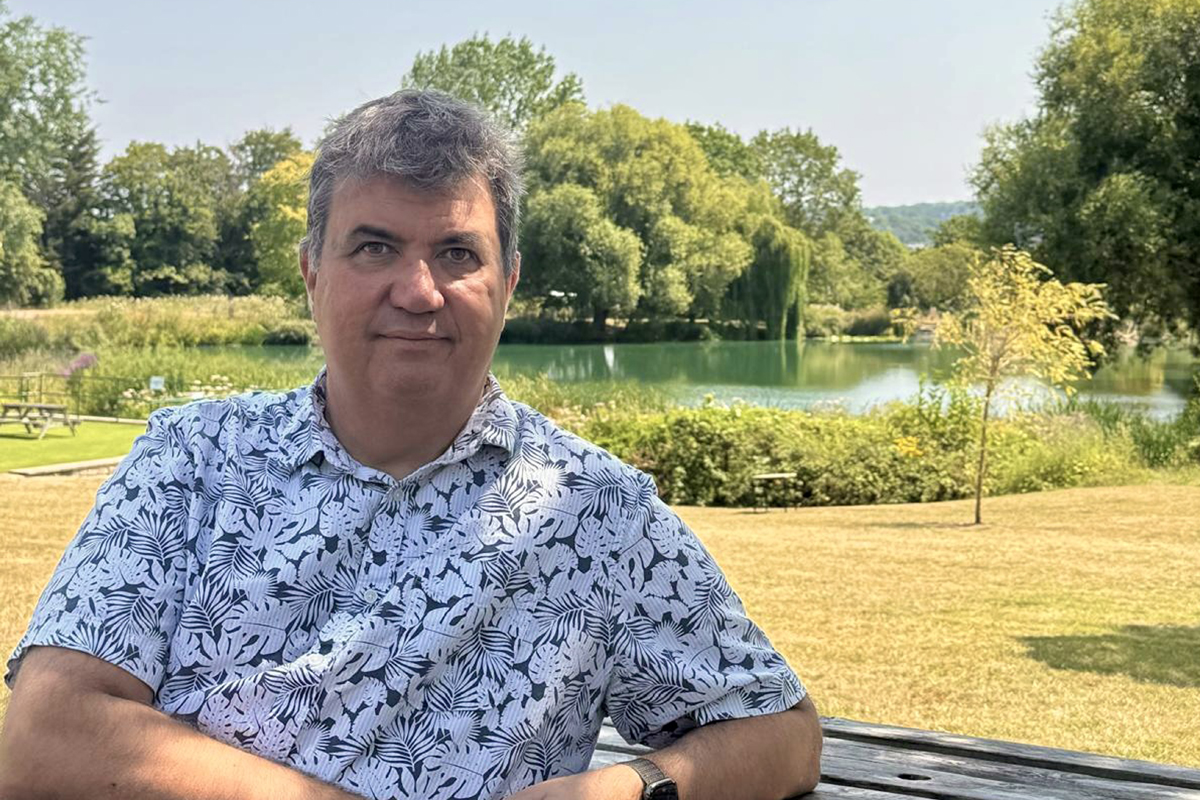
Looking back over all of this, the temptation is to pretend there was a magnificent masterplan that got me here.
There really wasn’t.
There were interests, accidents, opportunities, invitations, people who opened doors and other people who suggested I walk through them. Some decisions felt important at the time and turned out not to be. Others seemed almost incidental and ended up changing the direction of my life.
A leaflet through the letterbox led to law. A dinner I nearly skipped led to the WCIT. That led, eventually, to a school, a Charity and people who would reappear much later in entirely different parts of my life and lead me elsewhere. A conversation during an interview for the Family Bench led to the Inside Out Trust. A Lieutenancy Away Day led to the honours system.
None of that looks much like planning. What is clearer now is the thread underneath it.
I seem to have spent much of my life trying to understand how things work. At first that meant physical systems and software. Later it meant organisations, law, governance, risk, institutions and, increasingly, people. The systems became less predictable, the decisions became harder and the consequences became more important.
I also became steadily less interested in being the person who knew the answer and more interested in helping create the conditions in which good answers might emerge.
That has probably been the biggest shift.
In my twenties, I liked systems because they were logical. In my fifties, I am much more interested in the fact that most worthwhile systems aren't. They contain people, uncertainty, competing priorities, imperfect information and values that can't always be reconciled neatly. They still need structure and discipline, but they also need judgement, humility and occasionally the confidence to accept that the best available answer may still be imperfect.
The same is true of leadership.
The older I get, the less impressed I am by titles for their own sake. The interesting question is what happens around them. Whether people are able to do useful work. Whether institutions become stronger. Whether something continues after the person at the front has moved on. Whether the role leaves anything behind apart from a photograph and a line on a CV.
That has become increasingly important to me as I have let go of some things and taken on others.
I am no longer a Family Court magistrate. I am no longer Chair of the WCIT Charity. I am no longer Master of the WCIT, although, after a little light dry cleaning, the gown survived perfectly well without me.
Other responsibilities have grown instead. The Parole Board remains a major part of my working life. Prior’s Court and the Inside Out Trust bring different forms of governance and responsibility closer to home. The Lieutenancy has connected me more deeply with Berkshire and the people who quietly make communities work. The honours work has given me another perspective on public service and what exceptional contribution really looks like. Writing, legal education and technology are still there too, sometimes in different forms, but never very far away.
So the strands have not really converged into one career.
But then again, they’ve never had to.
What they have converged into is a way of thinking about work: understand the system, take the responsibility seriously, pay attention to the people affected by it, try to make useful things happen and leave enough behind for somebody else to carry on without you.
I still don’t have a career plan. It’s probably a bit too late for one now.
But I do now have a much clearer sense of what I want the next part of my working life to contain: useful work, good institutions, thoughtful decisions, interesting people and opportunities to make a positive difference where I can. Maybe that will be the Great and Very Important Thing that the illegitimate son of a Polish immigrant and a one-legged telephonist can use to finish his one-sentence autobiography.
Which, given how all this started, is probably as close to a plan as I am ever likely to get.