It's always the quiet ones
Some of the best leaders I’ve known have been the quiet ones: people who listen, make space for others and understand that leadership isn’t always about being the person at the front.
They say it’s always the quiet ones.
Usually, they mean serial killers. The ones who kept themselves to themselves. Didn’t have much to do with their neighbours. Always put their bins out on time.
But, in my experience, this applies to great leaders too. Leaders who don’t make a fuss, listen more than they speak, and read the room rather than dominating it. And leaders who know how and when to delegate, and when to allow room for others to step in, lead for themselves and develop their own skills.
Continuing the slightly clumsy metaphors, I can’t dance. Not even slightly. Never have been able to and almost certainly never will. Some would kindly say I have two left feet. Others, more realistically, would say I have two left hooves. I’ve never understood the whole fuss about Strictly. But what I do know, is that - when dance is done well - someone is always stepping out of the way so the other can move forward. Ideally without trampling each other. It’s that reciprocity and awareness of others that makes the movement work.
My journey into volunteering began when I was asked to become a trustee of a charitable trust connected to the tech company I worked for at the time. It was called the ‘Aspects of Life Fund’ and made grants to support disadvantaged youth. I didn’t exactly know what it would involve, but it felt important, and there were always really good sandwiches at the trustee meetings. So, I said yes. That simple step ended up leading to a lifetime of continuous voluntary service.
Since then, I’ve served as a trustee, chair, school governor, and mentor across organisations working in education, justice, digital inclusion, complex needs autism, and more. Some roles were strategic, others hands-on. And while this might seem like a random mix, all of them needed the same three things: quiet leadership, clarity of thought, and kindness.
Kindness has been the uniting thread in many ways. My Coat of Arms, granted by the College of Arms in 2016, carries the motto Erga Omnia Beneficentia: kindness in all things. It’s there to remind me to try and act with the sort of kindness that helps shape responsible decision-making. The sort of kindness that tries to listen, remembers that every decision involves people, and never forgets what volunteering should really be about.
I’ve co-founded a new school, watching it go from an idea literally on the back of a napkin, to a cardboard model in a Livery Hall, and then - via a multi-million-pound funding agreement and a very large hole in the ground - to become Hammersmith Academy. I've reconnected with my old school. I’ve seen grants of all sizes make real and tangible differences to organisations of all sizes. I’ve seen the impact of funding on PhD medical research and witnessed how public understanding and awareness of the killer that is bowel cancer (and which I still haven't forgiven for taking my father from me) has sprung from the critical illness of an inspirational cancer survivor. And I’ve watched technology expand horizons for life-limited children and their families.
But what stays with me just as much are the quieter moments. A conversation with a family living with the fact that one of their loved ones had gone missing – simply disappeared. An email from a probation practitioner that told us that a grant of £50 had helped keep a prisoner’s resettlement on track. And those moments of silence that have followed the making of difficult decisions.
Leadership, especially voluntary leadership, requires more than commitment. Alongside kindness, it requires reliability, dependability, approachability and enthusiasm. It requires knowing when to move forward, when to keep things as they are, and when to step back and leave things to others. It’s not the same as being passive. But the activity is around staying thoughtful, and grounded. In my experience, that kind of leadership builds trust, resilience, and sustainable change. And over time, it earns respect.
I’ve been fortunate to learn from many people, but two deserve a particular mention. Sir Kenneth Olisa OBE, whose clarity of thought can be disarming, occasionally frightening and inspiring in equal measure and whose every decision is grounded in humanity and wisdom. And Dame Stephanie Shirley CH, who has lived a life of humility, courage, and strength.
Although I have begun to plan the handover of some long-held roles, I’m not stepping back from service, but moving forward into a new phase. One in which I’m going to focus on work with national and, where appropriate, international reach, as good ideas don’t have boundaries. And neither should they.
Volunteering has shaped how I think, how I lead, and how I connect with people. It’s shown me that quiet leadership, clarity of thought, reliability, enthusiasm and kindness (in all things) can make a real difference.
So maybe they’re right. Maybe it is always the quiet ones.
Origin story
I first wrote and published this piece on LinkedIn about a year before my term as Chair of the WCIT Charity was due to end. This prompted a reflection my time as a volunteer and a charity leader along with some people that had inspired me along the way.
Since publishing the article, Dame Stephanie Shirley CH has died. She was an inspiration to so many people and will be greatly missed. Her autobiography Let It Go is definitely worth a read. And her selfless acknowledgement of the contributions of others exemplified her attitude towards leadership. The copy of Let It Go that she sent me had an unexpected message. It is now, of course, a very special memento of a remarkable woman.
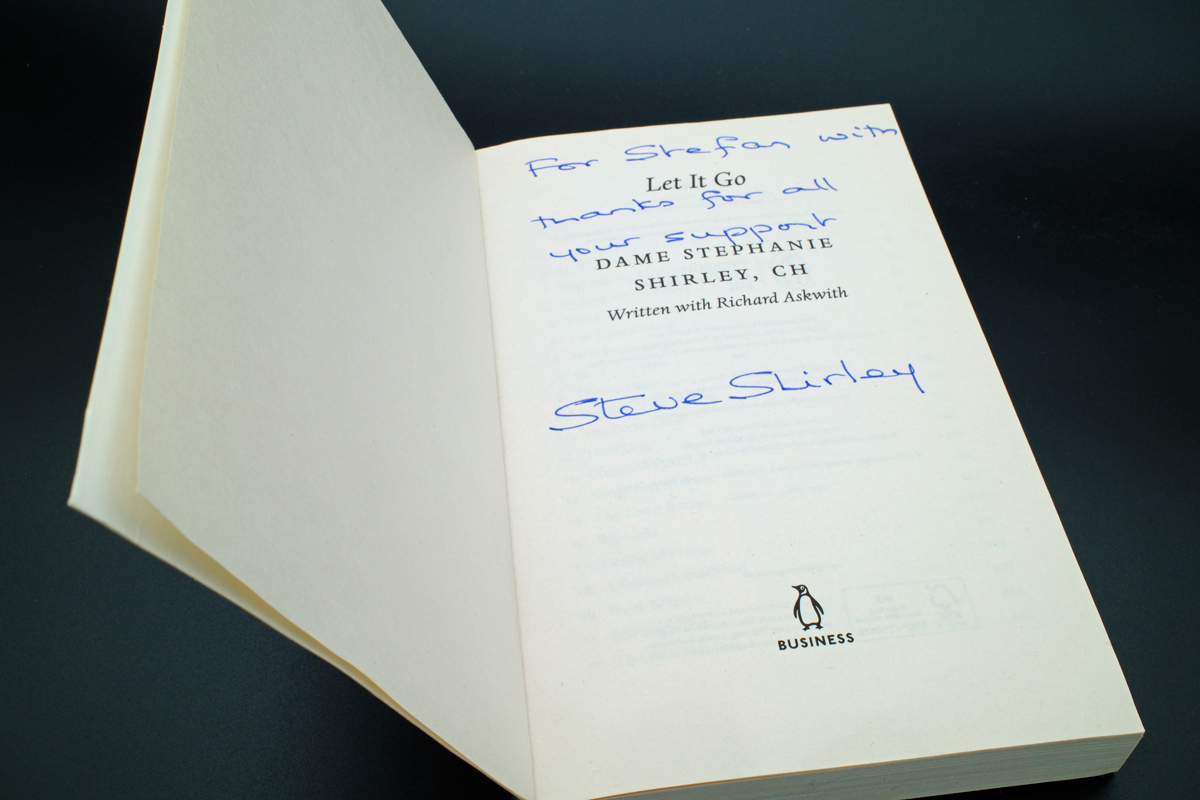
My copy of Let It Go, signed by Dame Stephanie Shirley CH.